


Authors’ Note:
Building upon our previous analysis in “The Killing of Informed Consent: A Case for Procedural Fraud,” which detailed the historical and social mechanisms used to erode medical autonomy, this article serves as its legal and practical continuation. Herein, we present the precise legal architecture required to expose this constructive fraud in court and systematically pierce emergency liability shields.
Introduction
The contemporary world is increasingly subjected to what observers have described as controlled societal demolitions.[1],[2],[3],[4] Researchers more and more view the post-9/11 era as a pivotal turning point, one that accelerated fundamental structural shifts in global governance.[5] This period has been characterized by cascading crises: prolonged geopolitical conflicts in the Middle East,[6] systemic shocks to global financial stability[7] (2007), and, most recently, unprecedented interventions affecting personal health,[8] the traditional doctor-patient relationship,[9] informed consent,[10] the basic rights to privacy[11],[12], civil liberties,[13] and even traditional currency mechanisms[14],[15]. While these events may appear disparate, their cumulative effect — increased centralization of authority over private transactions and individual autonomy — suggests a general trajectory driven less by random historical forces and more by the systematic erosion of established legal and ethical boundaries.
General Smedley D. Butler warned the public about the dangers of vested interests keen to send young men to an early grave in conflicts arranged to consolidate profits for huge international banking houses and corporations. In War is a Racket, Butler writes that a “racket” is “something that is not what it seems,” that only “a small inside group knows what it is about,” that it is “conducted for the benefit of the very few,” and it comes at “the expense of the very many.”[16] If war brings both destruction and profitable gain, we may also be able to see how contemporary campaigns reprise the time-tested strategies discussed by Butler and how, in these times, not merely fighting men but whole families, communities, and societies have become a new kind of cannon fodder.
Various criminal and civil suits lodged over the preceding six years alone indicate that the widespread destruction we have observed had been carefully planned over decades. As of this writing, the most recent arguments outlining organized criminal activity[17] presuppose that complaints will be heard in courts uncorrupted by outside influences. Given the complexities of this current war and the sophisticated forms of rhetorical and material camouflage used to conceal activities characteristic of destruction, we offer a model that brings into sharper focus the machinations necessary for the so-called Fourth Industrial Revolution[18] moving nations toward a global Bio-Security State. This model proposes that the dismantling of informed consent may be legally analyzed and understood through the doctrine of constructive fraud.
The Context of a Strategic Business Model: The ‘Al Capone’ Method
Highly decorated for his work in making Mexico safe for American oil interests, Haiti and Cuba civilized for National City Bank, “raping half a dozen” other Central American republics for Wall Street, and helping to “purify” Nicaragua for Brown Brothers international banking, General Smedley D. Butler grieved in retirement his long record of exemplary service. The “record of racketeering,” he observed, “is long.” Perhaps it is not a coincidence that Butler had served and later reflected on that work during the same period in which organized crime saw colorful figures such as Bugsy Siegel, Meyer Lansky, Lucky Luciano, and Al Capone circumvent laws to build illicit alcohol and drug empires during the Prohibition Era. The historical paradigm in which Al Capone and his contemporaries worked, in fact, provides a useful foundational logic for penetrating and understanding organized, state-corporate machinations in contemporary life. In the 1920s, public consensus recognized Capone’s involvement in murder, yet law enforcement failed to secure convictions on those grounds. The protective barriers seemed insurmountable: witnesses were silenced, evidence was circumstantial, and the partly camouflaged architecture of organized crime provided impenetrable plausible deniability.
This historical impasse directly parallels contemporary efforts to litigate “vaccine toxicity” and causal links leading to injury and death. Attempting to prove direct molecular or epidemiological causality in heavily captured regulatory environments has, thus far, proven to be a scientific quagmire. Data and data analysis are often obfuscated and resulting harms routinely dismissed as coincidental or perceived to be statistically outweighed by projected benefits. Circumstantial evidence through logical inference too often remains the most effective counter to the highly protected business operation. Engaging the system on the battlefield of scientific causality ensures an unwinnable war of attrition.
Capone, however, was ultimately neutralized not through homicide statutes, but via tax evasion.[19] Investigators abandoned the pursuit of charges of kinetic violence against Capone and focused exclusively on financial ledgers. Documents do not rely on subjective interpretation; numbers, like the sexes, are binary. Capone’s eventual conviction required no proof of malice nor intent — only the objective fact of omission.
This precise logic is the motivation for the construction of our proposed Constructive Fraud Model (CFM). The forensic accountant who audits the pharmaceutical industry and regulatory apparatus bypasses the necessity of proving intentional harm. The material fact is that package inserts and procurement contracts failed to disclose the presence of SV40 sequences,[20] and the critical manufacturing switch from Process 1 (clinical) to Process 2 (commercial)[21]. This switch was predicated on a regulatory acceptance of ‘chemical equivalence,’ a scientific fiction that deliberately ignored the novel in vivo behavior of LNP-encapsulated DNA — and the early accumulation of severe adverse event reports.[22]Like tax evasion, this failure to disclose, if legally established, may constitute a violation. The regulatory agencies and manufacturers colluded to systematically lower the safety thresholds — authorizing an unproven ‘equivalence’ — and concealed this degraded standard from the public and the medical community. This systemic collusion constitutes constructive fraud.
Crucially, this objective failure to disclose constitutes constructive fraud, which is legally sufficient to void mutual assent and pierce preliminary liability shields. If documentary evidence further demonstrates that regulatory agencies possessed undisclosed knowledge of the Process 1 to Process 2 alterations and the SV40 presence, yet authorized the product while withholding this data from the public, they cease to be defrauded authorities and legally become co-conspirators. At this stage, the violation escalates from constructive fraud to fraudulent concealment (actual fraud). This transforms the regulatory apparatus and the manufacturers into a consolidated criminal enterprise, fully actionable under the Racketeer Influenced and Corrupt Organizations (RICO) Act.
The Mechanisms of Constructive Fraud
Constructive fraud shifts the analytical framework from subjective malice to objective statutory and contractual duties of disclosure.[23] Violations arise from principles rooted in trust and contract law rather than conventional negligence. In contract and tort law, the concealment of material facts completely destroys the foundational requirement of mutual assent and informed consent. Where severe information asymmetry exists, the failure to disclose critical data constitutes fraudulent concealment, which is legally equivalent to active deception, thereby rendering any extracted consent fundamentally void. Furthermore, when the state effectively suspends individual autonomy and mandates medical interventions under emergency powers, it fundamentally alters the legal relationship. By eliminating the individual’s right to refuse, the state and its contracted manufacturers automatically assume a strict, non-delegable fiduciary duty to the public, establishing the exact confidential relationship required for constructive fraud. Let us consider the following two key points.
- Universal Consumer Logic over Scientific Attrition: Scientific discourse peculiar to complex molecular biology, for example, easily alienates the general public. What useful information, for instance, can be gleaned by concerned citizens encountering esoteric jargon: “genomic insertion risks of SV40 promoters”? Contract law and consumer rights are generally understood. If a vendor substitutes pork for a product labeled “100% Beef,” the switch is universally recognized as fraud. This analytical approach strips informed consent of its arcane and ambiguous “medical ethics” defense and redefines it as a strict legal contract: the exchange of accurate information for bodily access. In contract law, subjective ethical justifications for withholding data are irrelevant; the only binary metric is whether the delivered product matched the agreed-upon specifications. Framing the deployment of undisclosed biological components as “product mislabeling” or “concealed defects” circumvents the highly polarized “anti-vax” psychological barrier. It elevates the argument from a fringe scientific dispute to a fundamental breach of consumer protection and contract. Consequently, the legal definition of “damages” shifts fundamentally. To succeed, plaintiffs are not required to prove complex biological toxicity or individualized physical injury. The actionable damages are strictly defined as the economic fraud executed against taxpayer funds for non-compliant products, coupled with the absolute, procedural deprivation of the fundamental human right to informed consent.
- The Unification of the Defrauded: This model neutralizes the manufactured division between the vaccinated and the unvaccinated. Under the framework of commercial fraud, the vaccinated are no longer framed as having “taken poison” — a framing that triggers immediate psychological defense mechanisms. Instead, they are correctly identified as the principal victims of consumer fraud. Furthermore, demonstrating that taxpayer funds were allocated for procurement of defective, non-compliant products will unify populations across the political spectrum against systemic corruption.
The Chain of Liability and Vitiated Consent
The implementation of the CFM requires a strict redefinition of the actors involved, particularly the medical community.
Information Asymmetry and the Learned Intermediary Doctrine: Practicing physicians do not possess the independent means to sequence pharmaceutical products. Their clinical methods and risk-benefit assessments depend almost exclusively on regulatory documents and package inserts — the “Master Source.” Under the Learned Intermediary Doctrine, pharmaceutical manufacturers discharge their duty to warn patients by providing adequate warnings to the prescribing physicians.[24] Furthermore, under § 6(d)(2) of this very doctrine, the mass deployment of these products in environments lacking individualized clinical assessment entirely nullifies this intermediary defense, imposing a direct and non-delegable duty on the manufacturer to warn the patient. Whether by structurally bypassing the physician in mass immunization centers or by compromising the Master Source with omitted material facts — such as SV40 promoter-enhancer sequences, the Process 1/2 manufacturing switch, and early adverse event data — the manufacturer fundamentally breaches its duty through fraudulent concealment. Consequently, any informed consent obtained from the patient is inherently void, and the unwittingly compromised physician is reduced to an unwitting intermediary in the distribution of a defective product.
It may be successfully argued that physicians were structurally utilized as unwitting intermediaries best positioned to distribute an unauthorized product. Crucially, the status of the physician as an unwitting intermediary is temporally bound. Upon clinical observation of accumulating adverse events, the physician’s ethical duty to report (Hippocratic obligation) is activated. However, the systemic implementation of top-down administrative coercion — such as threats of medical license revocation for disseminating “misinformation” — structurally neutralized this reporting mechanism. Thus, the institutional apparatus effectively weaponized the medical community, transforming them from defrauded practitioners into forced participants.
Consequently, informed consent was fundamentally broken at the institutional level. The medical community, thus, represents a defrauded entity; whose professionals in clinical practice were contracted to administer a safety-confirmed pharmaceutical but who were, instead, supplied with an undisclosed genetic product. Identifying physicians as co-plaintiffs and primary victims of this constructive fraud serves as an irrefutable legal mechanism in dismantling the great deception, systematically proving the destruction of ‘reliance’ — the core requisite for fraud — without needing to litigate individual patient cases. Rather than fearing malpractice litigation from patients, medical professionals must recognize their shared victimhood. Uniting with the public against the true architects of this deception shifts the vector of liability back to its origin, serving as the ultimate gamechanger in this legal battlefield.
Surmounting Psychological and Methodological Barriers
The primary friction that prevents the widespread adoption of this procedural model lies in human psychology. Let us consider the following weaknesses:
- Intellectual Vanity: To validate their expertise, scientific and medical experts often desire to win through raw data and the self-evident logic of biological imperatives. Winning via a legal or administrative technicality may be perceived as an intellectual retreat that keeps the prideful contained in countless, unwinnable scientific debates.
- Moral Superiority: To sustain the self-constructed narrative of a heroic campaign against perceived “evil,” activists frequently demand proof of malevolent intent. Constructive fraud reduces the opponent to a negligent or fraudulent commercial entity that denies the hero the emotional satisfaction of a grand conspiracy trial.
- The Natural Demand for Spectacle: To members of the general public psychologically conditioned by bread and circuses and fooled into compliance with fraud, many outraged citizens may demand punitive criminal accountability. In witnessing such systemic institutional failures managed, in part, by their own leaders, the public would naturally expect a dramatic “smoking gun” and equally dramatic justice; however, a victory achieved through banal, administrative non-disclosure violations appears anticlimactic. Such a route remains, in our view, the most structurally sound mechanism for accountability.
Critical Methodological Vulnerability (Unknown Unknowns)
To render this model structurally impenetrable, a critical “Unknown Unknown” must be addressed within the framework of government procurement.
The reliance on “Breach of Contract” assumes standard commercial law applies. However, Advanced Purchase Agreements (APAs) and Emergency Use Authorizations (EUAs) negotiated during the declared pandemic often contained unprecedented, sweeping liability shields, indemnification clauses, and relaxed regulatory thresholds. [25]
The most absolute iteration of this constructive fraud occurs if the procurement operated under a National Security or Military Defense framework (e.g., DoD Other Transaction Authority), legally classifying the products as military “countermeasures” rather than civilian pharmaceuticals. If non-disclosure is defended as a requirement of state secrecy, the fundamental fraud shifts to jurisdictional deception. Marketing a classified military countermeasure to non-combatant civilian populations under the deceptive guise of a standard public health initiative constitutes the ultimate procedural fraud. It replaces the lawful paradigm of civilian informed consent with an unacknowledged theater of war, completely invalidating any extracted compliance.
Furthermore, even if emergency statutes or military contracting frameworks (e.g., DoD Other Transaction Authority) legally permitted a degradation of product specifications, the government possesses no legal authority to vicariously waive a citizen’s fundamental right to bodily integrity. Voluntary informed consent is a non-derogable human right (jus cogens) established in post-WWII jurisprudence (Trials of War Criminals before the Nuremberg Military Tribunals under Control Council Law No. 10. (1949). The Nuremberg Code. Washington, D.C.: U.S. Government Printing Office.); it cannot be legally suspended even under military necessity or national security mandates. Any contract authorizing the mass deployment of biologically active, undisclosed genetic material — under the guise of an emergency — bypasses informed consent and constitutes an ultra vires act (acting beyond statutory authority) and a direct violation of peremptory international norms.
Additionally, to overcome the absence of direct privity of contract between manufacturers and individual citizens, this model invokes the doctrine of the Third-Party Beneficiary Contract.[26] Because the government executed these APAs using public trust and taxpayer funds explicitly for public health, citizens are the legitimate end-beneficiaries. Critically, even if these government contracts explicitly contain standard “No Third-Party Beneficiaries” clauses, the concealment of material manufacturing alterations (e.g., undisclosed genetic sequences) in biological products intended for mass human administration constitutes a gross violation of public policy. Such systemic deception triggers mandatory consumer protection and anti-fraud statutes, rendering any contractual privity exclusions or liability shields inherently null and void (American Law Institute. (1981). Restatement (Second) of Contracts § 195 (Term Exempting from Liability for Harm Caused Intentionally, Recklessly or Negligently). See also Tunkl v. Regents of University of California, 60 Cal. 2d 92 (1963), which established that exculpatory clauses are void against public policy when they involve essential services affecting the public interest. This elevation from commercial breach to a violation of inalienable rights grants the public direct legal standing to sue, bypassing traditional privity limitations. Consequently, any data concealment by the manufacturers constitutes procedural fraud and a material failure to warn the ultimate beneficiaries.
Practically, this barrier is pierced utilizing mechanisms such as the False Claims Act (FCA) and its Qui Tam provisions (False Claims Act, 31 U.S.C. §§ 3729-3733). By delivering a commercial product (Process 2) that materially deviated from the clinical trial specifications (Process 1) contracted by the government, the manufacturers committed actionable fraud against the public treasury. The Qui Tam framework allows defrauded citizens to litigate on behalf of the state, transforming objective manufacturing discrepancies into severe financial liability entirely independent of emergency health statutes.
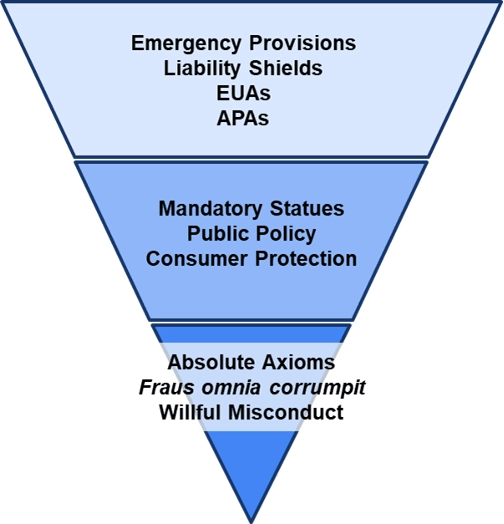
If the government contracts explicitly or implicitly waived the requirement for standard manufacturing exactitude under emergency provisions, the “product defect” argument faces a severe jurisdictional barrier. To neutralize this jurisdictional barrier, the Constructive Fraud Model (CFM) presented in Figure 1, must explicitly integrate the legal doctrine of fraus omnia corrumpit (fraud vitiates everything).[27]
Furthermore, this reliance on fraus omnia corrumpit is fully compatible with statutory emergency frameworks, such as the US PREP Act, which explicitly retains liability exemptions for “willful misconduct” (Public Readiness and Emergency Preparedness (PREP) Act, 42 U.S.C. § 247d-6d(d) (Exception to Immunity for Willful Misconduct)). The documented, systemic concealment of the Process 1 to Process 2 manufacturing alteration, combined with the omission of SV40 sequence data from regulatory filings, meets the exact statutory definition of willful misconduct, thereby piercing the liability shield using the statute’s own embedded legal parameters.
The entire deception rests upon the media-manufactured legitimacy of broad EUAs or orders, easily re-activated at any given time by politically driven emergencies, but the true foundation at the bottom of our model is composed of highly precise laws. The inverted triangle reveals how tenuous and easily toppled the whole illusion is. A traditional pyramid with a broad base suggests legal stability, permanence, and a natural order. However, the current legal paradigm surrounding EUAs and liability shields is inherently top-heavy, unnatural, and highly unstable. Our model frames the actual illusion of an impenetrable fortress, illustrating how a massive, sprawling apparatus of emergency orders is precariously balanced on a singular, highly precise foundational point: the assumption of lawful consent and the absolute absence of fraud.
Crucially, this doctrine is not a localized legal loophole but a universal axiom of jurisprudence. Rooted in Roman law, it operates uniformly across Common Law precedents, Civil Law statutory codes (e.g., Article 96 of Japan’s Civil Code)[28], and international treaties (Article 49 of the Vienna Convention).[29] Any legal challenge utilizing the CFM (or: The plaintiffs) must demonstrate that the withholding of data (e.g., the July 2021 adverse events and SV40 presence) constitutes a breach of the fiduciary duty of good faith and fair dealing — a foundational requirement that cannot be legislatively or contractually waived, even under emergency statutes. By anchoring the demolition of consent not just in missing data, but in the violation of non-delegable duties to warn and disclose material facts, the legal architecture becomes absolute; any court that denies this axiom inherently invalidates the foundations of its own legal system.
Further, even if a heavily captured judiciary dismisses such claims by attempting to hide behind emergency liability shields, this outcome still serves its ultimate strategic function. A judicial dismissal in the face of documented constructive fraud creates an undeniable, historical public record that the system officially sanctions state-corporate deception. Thus, whether through a legal victory or an exposed judicial cover-up, this CFM ensures the irreversible demolition of public consent.
While constructive fraud establishes the baseline of liability, the systemic and deliberate concealment of known material facts (such as SV40) elevates the violation to willful misconduct and fraudulent concealment. Crucially, the objective documentary omission of these facts provides the ‘clear and convincing evidence’ required to bypass the protective scope of any emergency immunity statutes. Finally, the doctrine of fraudulent concealment tolls the statute of limitations until the objective discovery of these highly obscured material facts, neutralizing any procedural attempts to dismiss the case as time barred.
Conclusions
We reference here the October 2024 landmark ruling by the District Court of Northern Netherlands, which formally established legal jurisdiction to hear a civil liability lawsuit against Bill Gates, Pfizer CEO Albert Bourla, former Dutch Prime Minister Mark Rutte, and members of the Dutch Outbreak Management Team.[30] Brought initially by seven individuals suffering from documented injuries following the administration of COVID-19 genetic products, the complaint alleges that these key stakeholders named in the suit had systematically misled the public, fully aware that the products’ safety profiles did not align with the ubiquitous marketing claim of being “safe and effective.”
This judicial decision to pierce international liability shields is not merely a localized legal anomaly; it represents a structural fracture in the protective architecture surrounding the global pharmaceutical paradigm. It demonstrates that when challenged under the strict metrics of civil liability, non-disclosure, and procedural fraud, the foundational house of cards constructed by global health authorities is profoundly vulnerable. Finally, compounding the problem of integrity in the present structure of the pharmaceutical complex is a RICO complaint against the American Academy of Pediatrics.[31] This raises further concerns regarding racketeering within an industry traditionally shielded by the veneer of medical authority.
References
[1] Agamben, G. 2004. State of Exception. Chicago: Chicago University Press. Online: https://academic.oup.com/icon/article/4/3/567/646395
[2] Perkins, J. 2004. Confessions of an Economic Hit Men. Online: https://www.penguinrandomhouse.com/books/726382/confessions-of-an-economic-hit-man-3rd-edition-by-john-perkins/
[3] Kyrie, V. and Broudy, D. 2022. The Covid-19 Concoction: A Recipe for Successful Psychological Operations. Propaganda in Focus. Online: https://propagandainfocus.com/the-covid-19-concoction-a-recipe-for-successful-psychological-operations/
[4] Hughes, D. 2024. Covid-19, Psychological Operations, and the War for Technocracy, Cham, Switzerland: Springer Nature. Online: https://link.springer.com/book/10.1007/978-3-031-41850-1
[5] Clark, W. 2007. Gen. Wesley Clark Weighs Presidential Bid: ‘I Think About It Every Day,’ Interview on Democracy Now. https://youtu.be/fAnNJW9_KYA?t=81
[6] Walzer, M. 2006. Regime Change and Just War. Dissent. Online: https://www.ias.edu/sites/default/files/sss/pdfs/Walzer/RegimeChange.pdf
[7] Read, C. 2009. Global Financial Meltdown: How We Can Avoid the Next Economic Crisis. New York: Palgrave Macmillan. Online: https://link.springer.com/book/10.1057/9780230595187
[8] React19. 2025. Scientific Publication Directory. Database. https://react19.org/science
[9] Oversight. 2023. Hearing Wrap Up: COVID-19 Mandates Fractured Physician Autonomy, Doctor-Patient Relationships. Committee on Oversight and Government Reform. Online: https://oversight.house.gov/release/hearing-wrap-up-covid-19-mandates-fractured-physician-autonomy-doctor-patient-relationships/
[10] Broudy, D. and Ueda, J. The Killing of Informed Consent: A Case for Procedural Fraud. Propaganda in Focus. Online: https://propagandainfocus.com/the-killing-of-informed-consent-a-case-for-procedural-fraud/
[11] Sharma, T., Bashir, M. 2020. Use of Apps in the COVID-19 Response and the Loss of Privacy Protection. Nat Med 26, 1165–1167 (2020). https://doi.org/10.1038/s41591-020-0928-y
[12] dos Reis Peron., A. E., de Magalhães, D. A. M., D., and Caetano, G. F. (2025). Beyond Digital Repression: Techno-authoritarianism in Radical Right Governments. Cogent Social Sciences, 11(1). https://doi.org/10.1080/23311886.2025.2528457
[13] West, P. 2025. How ID Cards Destroy Freedom. Spectator. Online: https://spectator.com/article/how-id-cards-destroy-freedom/
[14] Broudy, D. and Arakaki, M. 2020. Who Wants to Be a Slave? The Technocratic Convergence of Humans and Data. Frontiers in Communication. 5:37. Online: https://www.frontiersin.org/journals/communication/articles/10.3389/fcomm.2020.00037/full
[15] Ng, J. 2023. Digital Money, Digital Exclusion: CBDCs and Human Rights. International Law and Politics. 55:393. Online: https://www.nyujilp.org/wp-content/uploads/2023/05/Commentary2.pdf
[16] Butler, S. D. 1935. War is a Racket. Heritage History. Online: https://www.heritage-history.com/site/hclass/secret_societies/ebooks/pdf/butler_racket.pdf
[17] CHD. 2026. CHD Files Landmark RICO Lawsuit Against the American Academy of Pediatrics. Children’s Health Defense. Online: https://childrenshealthdefense.org/aap-rico-lawsuit/?itm_term=home
[18] Schwab, K. 2015. Interview with Charlie Rose. Charlie Rose. Online: https://charlierose.com/videos/23789
[19] FBI. Al Capone. FBI History Famous Cases. Online: https://www.fbi.gov/history/famous-cases/al-capone
[20] Speicher, D. J., Rose, J., and McKernan, K. 2025. Quantification of residual plasmid DNA and SV40 promoter-enhancer sequences in Pfizer/BioNTech and Moderna modRNA COVID-19 vaccines from Ontario, Canada. Autoimmunity, 58(1), 2551517. https://pubmed.ncbi.nlm.nih.gov/40913499/
[21] Tinari S. The EMA Covid-19 Data Leak, and What it Tells Us about mRNA Instability. BMJ. Online: https://pubmed.ncbi.nlm.nih.gov/33692030/
[22] Pfizer. (2021). Cumulative Analysis of Post-Authorization Adverse Event Reports of PF-07302048 (BNT162B2) Received Through 28-Feb-2021. (Released via FOIA request). Public Health and Medical Professionals for Transparency.
[23] Garner, B. A. (Ed.). 2019. Black’s Law Dictionary (11th ed.). Thomson Reuters. Online: https://www.wildy.com/isbn/9781539229759/black-s-law-dictionary-10th-ed-hardback-thomson-west-fa0f3dac-52d1-4b9a-b103-1c6d14fe84f5
[24] American Law Institute. 1998. Restatement (Third) of Torts: Products Liability § 6(d). Online: https://scholarlycommons.law.hofstra.edu/cgi/viewcontent.cgi?article=2010&context=hlr
[25] Public Citizen. 2021. Pfizer’s Power: Read the COVID-19 Vaccine Contracts. Online: https://www.citizen.org/article/pfizers-power/
[26] American Law Institute. (1981). Restatement (Second) of Contracts § 302 (Intended and Incidental Beneficiaries). Online: https://advance.lexis.com/open/document/openwebdocview/-302-Intended-and-Incidental Beneficiaries/?pddocfullpath=%2Fshared%2Fdocument%2Fanalytical-materials%2Furn%3AcontentItem%3A42GD-2SN0-00YG-M0CT-00000-00&pdcomponentid
[27] United States v. Throckmorton, 98 U.S. 61 (1878). (Lazarus Estates Ltd v Beasley [1956] 1 QB 702.) Online: https://tile.loc.gov/storage-services/service/ll/usrep/usrep098/usrep098061/usrep098061.pdf
[28] Ministry of Justice, Japan. (1896). Minpō (Civil Code), Act No. 89 of 1896, Article 96. Online: https://www.cas.go.jp/jp/seisaku/hourei/data/CC_2.pdf
[29] United Nations. (1969). Vienna Convention on the Law of Treaties, Article 49. Online: https://legal.un.org/ilc/texts/instruments/english/conventions/1_1_1969.pdf
[30] Judgment of October 16, 2024. Case number: C/18/228114 / HA ZA 23-239. ECLI:NL:RBNNE:2024:4284. Online: https://uitspraken.rechtspraak.nl/details?id=ECLI:NL:RBNNE:2024:4284
[31] Litigation Updates. 2026. Public Health Law Watch. Online: https://www.publichealthlawwatch.org/litigation-updates/2024/7/16/us-supreme-court-end-of-the-term-opinions
(Featured Image: “Health and the Law – Legal Issues – Malpractice and Doctors” by weiss_paarz_photos is licensed under CC BY-SA 2.0.)