
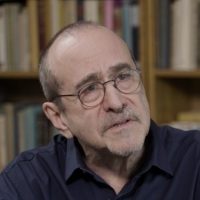

Editor’s Note: This interview with Professor Mark Crispin Miller (MCM) and Dr Amy Smiley (AS) was conducted by Professor Daniel Broudy (DB) in February 2026 and discusses the forthcoming film Reading the World: The Life and Times of Mark Crispin Miller. The interview can also be viewed here on the Propaganda in Focus YouTube page and the trailer to the film can be viewed here.
Introduction
DB: Welcome to another dialogue with Propaganda in Focus. I’d like to begin with a brief memory of my own, my initial attempts to understand in the early 1990s how the invasion of Panama in late 1989 was understood in two entirely different ways. On the ground in the capital city, we saw the faces of those whose lives had been turned upside down by the invasion, and on the television two entirely different faces, full of joy and jubilation. It wasn’t until a year later that I encountered an insight in a new book in the base library that helped me to reconcile those discrepancies and caused me to rethink how wars are advertised and sold to the public. Here’s that line …
Like propaganda generally advertising must pervade the atmosphere, for it wants paradoxically to startle its beholders without really being noticed by them. Its aim is to jolt us, not into thinking but specifically away from thought into a quasi-automatic action.
Well, that action is consumption without critical thinking. What are the dominant cultural forces that drive our thinking and our behaviors today? These are recurrent themes and questions addressed in the work of my guests, Professor Mark Crispin Miller and Dr. Amy Smiley. Mark is a recently retired professor of Media Culture and Communication in the Steinhardt School of Education at New York University where he taught since 1997. The book from which I drew that quotation about advertising is Boxed In: The Culture of TV. Some of Mark’s other books include The Bush Dyslexicon, Cruel and Unusual: Bush Cheney’s New World Order, and Fooled Again. Amy has a degree in 20th century French literature and was a professor at Johns Hopkins University as she went on later to become a psychotherapist and has a private practice in New York City. She’s also a writer of essays and fiction with her latest novel Hiking Underground, available on Amazon. She is also here with Mark to talk about their latest project, a new documentary film titled, Reading the World: The Life and Times of Mark Crispin Miller. So, welcome Amy and Mark and thank so much for joining.
I saw Manufacturing Consent in the mid-90s, and I’ve thought for many years that we also need a retrospective of Mark’s work, his life, his influences, and so I was really glad to see the trailer of the film last month. Can we first talk about the seeds for this documentary, when were they planted, and what was the tipping point to get the ball rolling, if you’ll excuse these mixed metaphors?
AS: Well, it was really my idea—in many ways a reaction to the pervasive propaganda of COVID from early 2020. It was a way for me to get much deeper into Mark’s work, into his thinking process, and also helped me better grasp the overall trajectory of his work, from close reading of literary texts to similar analysis of texts of all kinds: movies, then advertising, and eventually propaganda. I was particularly interested in this idea of Mark “reading the world,” which then led him into activism, initially focused on the threat posed to democracy by media concentration. From there he moved to the even greater danger posed by election theft; and eventually, of course, he turned to COVID, which has posed the greatest threat of all.
In studying Mark’s work, I also couldn’t help but see how he was steadily restricted as a public intellectual. From the late Seventies through the Nineties, he was always in demand as a critic and commentator, our phone always ringing with requests interview—and then it just stopped ringing, and Mark now had trouble getting published anywhere. I really wanted to understand why that happened. What was it about his thought that became so threatening? So the film is an investigation into propaganda generally, and also into the ways that propaganda was deployed to silence and discredit him.
DB: Right, it’s amazing isn’t it, when you look back over the past six years, and you can see the extent to which propaganda has had a profound effect even on academics who often profess themselves to be rational and scientifically-minded thinkers.
MCM: Yes. It’s the professional classes that are most to blame for the COVID catastrophe—which is not unprecedented, as much the same thing happened in Nazi Germany. This comes very clear in Victor Kemperer’s diaries. A Jew who had converted to Episcopalianism, and married to an “Aryan” woman, Kemperer gives us a very powerful, incisive day-to-day account of life under Hitler. At several points he notes that the regime’s most rabid supporters were not workers or the poor, but the most educated people—a point that Chomsky later also made when he was rational.
DB: Right, maybe we could talk about that at some point?
AS: Yes, I’d like to, since you mentioned Manufacturing Consent in your introduction. While there are many ways in which Mark and Chomsky are like-minded, especially around the issue of media concentration, there are several highly important episodes that Chomsky wouldn’t touch. His notion of propaganda was more limited than I had realized. Just before the Epstein/Chomsky story broke, Mark and I watched Manufacturing Consent again and were kind of astonished by how great a job he did on US foreign policy, whereas, domestically, he was completely unhelpful, turning a blind eye to the problem of election theft and, of course, COVID—the biggest propaganda coup in human history.
MCM: And the pivotal assassinations in the 60s and 70s. His anti-conspiracist stance naturally raised questions about his integrity. On the one hand, there are those who note, in his defense, that he’s such a rigid structuralist, and so intellectually arrogant, that he just blows off anything that doesn’t fit into his tidy schema—i.e., government-plus-big-media-equals-propaganda. That schema leaves no room for grand conspiracies like JFK’s assassination, and Martin Luther King’s, and 9/11, and so on. And then there are those who think that his decades of employment at MIT—
DB: —is interesting?
MCM: Well, yes, land let’s just leave it at that – “is interesting”! You know, I knew Chomsky. I put that in the past tense, though he’s technically still with us, because, having been jabbed and, no doubt, boosted, he had a major stroke, and he can no longer talk. He and I were on friendly terms, and I was part of an attempt to get him to open his mind about 9/11. It was fruitless. I also had an exchange with him about election fraud, but he just wouldn’t go there.
And when I came under attack at NYU, he did not help me. This is a long story that I don’t have time to tell fully, but they went after me for my approach to teaching propaganda. This was in the fall of 2020. As ever, I was teaching it with a focus on the present, encouraging students to learn how to spot propaganda, and then test its truth claims. As a purely hypothetical example, I suggested that one might study aspects of the COVID crisis—like, say, masking. If one were to write one’s paper on it, one would have to read through all the studies of that subject. All the randomized controlled trials, I told them, had found that masks do not block the transmission of respiratory viruses. One would have to read those studies, and the more recent studies finding otherwise.
This enraged a student who, instead of speaking up in class, went on Twitter a few days later and demanded that I be fired, “for putting the students at risk”—and NYU quickly backed her up.
DB: Yes, I remember that.
MCM: So I posted a petition at Change.org, basically just asking that NYU respect my academic freedom, and thereby set a positive example for other universities. And Chomsky refused to sign it. Nor is he the only former friend, on the so-called “left,” who would not support my academic freedom. Abby Martin wouldn’t sign it, either. These were just a few of the personal social losses that those of us who do this kind of work have been suffering, especially since COVID.
DB: Right. I would probably argue that the left, or our perception of what the left was at one point, has collapsed. But the right and the left have also kind of collapsed, especially over the last six years since COVID. I now see allies, who I used to think were my enemies pre-COVID, and with whom I can have rational conversations.
MCM: Well, yes, certainly on that subject, on the subject of science, the right, the libertarian right, and some of the Christian right, were much easier to talk to than the left. I mean, you could talk to them, or try, but you could not, and in many cases still cannot, disagree with people on the left. The brainwashing is staggering, and ultimately tragic.
We’ve lost some very dear friends, well-known people, renowned intellectuals and so on. And maybe in time that will change, but you’re quite right; the terms “left” and “right” have largely ceased to mean what they once meant.
Speaking of the right, it’s all too clear that Trump is off his rocker this time around; and I believe it’s because he was “vaccinated” and boosted since it’s had the same desublimating effect on millions of people worldwide. I’m more than aware of the danger that Trump poses to Constitutional democracy, but my unease extends beyond him to what the Democrats will do when they replace him. I don’t think that’s going to bode well for anybody, and I think they will double down on their Covidianism, disinclined to rethink anything.
They will simply feel vindicated, and they’ll demonize the right, and it’ll just go on and on. And I believe, as Amy makes clear at the very end of the trailer, that if we’re going to survive this moment, it can only happen if we unify. There must be unity. ‘We the people’ has to mean precisely that. We have to stop thinking in terms of right and left. We have to stop fighting. We have to stop going tribal on each other. And that’s a tall order; I really don’t know how we do it.
AS: And when we think about the four assassinations – JFK, Malcolm X, Martin Luther King, Jr., Robert Kennedy – we realize that all four of them were people who variously represented the idea of peace and unification; and they’re gone, it’s one of the greatest tragedies of humankind, as our politics now are totally divisive. So, as Mark says, it really is something that we need to transcend.
DB: Yes, Amy, you and Mark are not just friends and colleagues, but also obviously husband and wife. Surely you both value these same attributes: honesty, openness, truth, with one another, and I wonder if over the preceding six years, in the shadow of the global coronavirus theater, you and Mark have had to radically re-evaluate relationships, some of the relationships you’ve had, with others. Just to let you know, I’ve lost a number of really good friends and colleagues over the past five years alone, a total paradigm shift in my social relations with people. Have you had similar difficulties, given the huge gaslighting campaigns perpetrated?
AS: Of course we have, and, for me, the most devastating losses have been in my own family. I desperately wanted to see my father, and two of my sisters were adamant that I couldn’t see him unless I was vaccinated. It was absolutely a treacherous time from which I’m still recovering. But we must admit that even Mark and I, at the very start of COVID, were duped like everybody else. It took us about 3 weeks to figure out that we’d been had, and I was carrying – Mark didn’t want me to take the elevator – I was carrying groceries up 16 flights of stairs. We were in a trance of terror.
MCM: I have to say that I was much worse than Amy was. I mean, the reason why she had to walk up 16 flights of stairs was that, back then, I insisted on it. I fell hard for this thing because I was 70 years old, and battling Lyme disease. So I bought the whole thing. Though I allowed myself to take the elevator, I’d actually hold my breath, and press the button with my elbow! This is an interesting story, for I’d say it was about three months, not three weeks at least, that our son took her aside and said quietly, “Just take the elevator.”
AS: He couldn’t stand it anymore.
MCM: And he was absolutely right.
AS: And of course there was a lockdown here, with a curfew, and Billy – our son – and I used to walk around the neighborhood after hours. We just couldn’t help it, we had to be rebellious, we couldn’t stand it, and I refused to wear a mask. I’d walk in the middle of the street and sing. I just couldn’t take the heaviness and silence, and the fear; and I was the only therapist in my building, which has many suites of therapy offices, who did not abandon ship. I alone saw my clients in person, which gave me quite an insight into the psyche of many New Yorkers. It was really tough all around.
MCM: What woke me up? I think you’ll find this interesting. Back when I was still allowed to teach my propaganda course—before NYU ceased to let me teach it, because of my heresy on masking—I would always start the term by warning the class that the study of propaganda is very difficult. Not intellectually difficult, but socially and psychologically difficult, because, once you start looking into things as thoroughly and impartially as possible, you inevitably find that stories you had long believed, and often ardently, are actually false. So I ardently believed in the coronavirus. I was creeping around like everybody else.
And then I happened to watch a video on social media, made by a guy who went around the city with his phone and filmed hospital after hospital that was standing empty. Now, if your view of reality is restricted to something like The New York Times, there’s an unprecedented crisis, with our hospitals all overrun, right? This guy’s evidence prompted me to go out myself and walk past hospitals in the neighborhood, and sure enough there was nobody there. So here the press was making a big scary deal out of all those refrigerator trucks parked behind the hospitals to stack all those dead bodies. So I strolled past those those hospitals—and saw no traffic whatsoever in or around those refrigerated trucks, nor was there anybody in the lobbies. And then, you know, as one came to study COVID as propaganda, one made ever more frightening discoveries, such as the murderous practices at hospitals like Elmhurst in Brooklyn. The Times ran many lurid features about Elmhurst, with many photos of the overcrowded hallways, blah blah blah.
Well, it emerged a few months later, from a nurse who spilled the beans, that they were actually killing people in that hospital—killing them deliberately, because there was a bounty on COVID patients and COVID deaths, so this was not only a venal practice but a homicidal one, entailing so many thousands of dollars for every COVID patient and every COVID death, while morticians and pathologists were quietly incentivized to call every death a “COVID death,” whereas we later learned that just very few folks—usually with several comorbidities—died of COVID. And that eerily anticipated what has happened since the “vaccines” were rolled out, because once “vaccination” killing people all around the world, that enormous and unprecedented toll was, and is, completely blacked out by the press, still to this day.
It’s never covered; and that’s why those who don’t know my work may find my Substack enlightening (if they can stomach it). It’s called “News from Underground,” and one of the things we do every week is publish a compilation put together by a global team of researchers who are all doing this gratis. It has reports of all those people who have ‘Died suddenly’ over the previous seven days, or died of turbo cancer or died for no reason or died of natural causes at the age of 32, or died of myocarditis when they’re eight-years-old. You know, you have to have a memory of what obituaries were like pre-COVID in order to grasp how abnormal they are now. Without that historical memory, you can’t perceive the utter abnormality of obits nowadays. So it’s very important to remind people of that past so that will have some basis for comparison.
DB: It’s as if the so-called remedies are erasing vast quantities of information; our memories are being erased as well. One of my colleagues from the UK, with whom I had conversations in the past, before we ended our friendship, we were talking about a very similar topic to that which you just brought up about the incentivization of death by death in hospitals, and your comments reminded me of the stories that were coming out of the UK regarding Midazolam and the use of barbiturates.
MCM: Yes; and then there’s Canada, which has completely normalized assisted suicide. Thus Canada is now a death cult; and I don’t think discussion of it can be quite complete without our talking about the spiritual dimension of what’s going on. Though I’m not given to this kind of discourse, the whole thing definitely has an occult feeling to it, as a certain death-worship has gripped the medical establishment. I don’t hesitate to call what’s happened evil. The lockdown was evil, and then the “vaccination” drive was—is—evil, so it’s no surprise that Jeffrey Epstein was involved, along with Bill Gates, with the two of them intent on “getting rid of the poor people.” That’s evil, as the pseudo-science of eugenics is pure evil, and has been since its birth in the late 19th century.
DB: Can you tell us a bit about the principal aim of the documentary? Is it largely descriptive, or does it defend a thesis that maybe Mark has been arguing for years? I really like the observation that the film is an appeal to ‘the people’, a way of urging them to exercise their rights, especially, to think and speak freely.
AS: Yes. It’s an appeal for tolerance of dissent and dissenting views. During COVID, just to start with that, I could not understand why we didn’t have many scientists, and different points of view. Why was there only one point of view? Why was that? I found the groupthink terrifying. So in answer to your question, I think that the main purpose of the documentary is to use Mark as an example of someone who ‘reads the world’ and was cancelled for it, but who nonetheless has fought the good fight, and continues to fight for it; and that, through his example, we all may be able to ‘read the world’ and not be taken in. You know better than anyone that propaganda is the art of persuasion—and, once “persuaded,” people are as if under a spell. In short, the purpose of this documentary is to wake such people up.
MCM: This is particularly important at a time when it’s largely forbidden to question any propaganda story that is, on its face, preposterous, and those who dare contradict it are outcast. This started in 1967 when the CIA weaponized the phrase ‘conspiracy theory’ by sending Memo 1035-960 (which is online) to all their station chiefs worldwide, urging them to use their media assets, and others, to discredit people like Mark Lane and Sylvia Meagher, who were demonstrating quite successfully, and eventually convincing a majority of Americas, that the Warren Report was hogwash. The memo specifically instructed the use of the phrase “conspiracy theory” to tarnish that important work, and also coined the epithet “conspiracy theorist” to make those dissidents sound insane. Back then, and for several decades, those thus dismissed were being ridiculed. In this century, particularly under Obama (which is not to say that he was personally responsible for it), the tone of that slur began to darken in a very menacing way. Now “conspiracy theory” was no longer a laughing matter, but downright dangerous, seditious—a form of “domestic terrorism.”
We saw this in the hysteria over “January 6”—a psy-op managed by the FBI, and shrilly propagated all throughout the media; and, speaking of Jeffrey Epstein, I remember when Pizzagate was just such a story. You were not allowed to talk about it, despite the striking oddity of those emails from John Podesta, that were clearly using a code favored by pedophiles, according to the FBI. You could not talk about it, especially once they had Edgar Maddison Welch barge into Comet Pizza in D.C., and fire his rifle there, claiming to have come to liberate the children whom he thought had been imprisoned in the basement. That psy-op gave the scary misimpression that “conspiracy theory” could get people killed.
So you couldn’t talk about it; but it’s now clear to me that any story deemed taboo by all the media—not just the corporate press, but “alternative” media as well—get’s you jeered, or worse, if you dare go there. I was first canceled over my book Fooled Again (2005), because it dealt the theft of the presidential election in 2004.
AS: Let me step in to provide some important historical context: Mark was much celebrated back when he did close readings of ads or of certain political speeches—this was in the Seventies and Eighties. But when he aimed at larger targets, starting to work toward an institutional study of propaganda, by focusing, initially, on the fraudulence of elections in America, his work was far more threatening.
MCM: Right. Though, in the early to mid-Nineties, I was mocked for my activism around media consolidation—mocked by both the corporate and left press—I was not yet persona non grata. Daniel, you know from the film trailer that I was on the CNN show “Reliable Sources,” where they made fun of me, which I expected. But they did have me on. By contrast, when I argued that the 2004 election had been stolen, I crossed a red line. Any such claim is forbidden by “our free press,” which reflexively, and univocally, calls it “false.”
Of course, we see this constantly vis-a-vis the 2020 election. Any claim by Trump or any MAGA type that that presidential race was rigged is automatically dismissed by “our free press” as pure delusion, based on “no evidence” at all; when in fact there’s copious evidence to back that charge; and I will bet $1000 that not one of those reporters knows Jack-shit (excuse me) about elections, how they’re run and how they’re stolen. That’s another movement that I joined, after failing to reverse the trend of media concentration (a fight I waged almost completely by myself). Starting in 2000, there was small but dedicated movement for radical reform of our abysmal voting system.
It wasn’t until 2020 that I realized that most of the members of that movement—not all, but most of them—were really only interested in thefts from Democrats. So we were all unified in digging into the 2000 and 2004 elections, which were both unquestionably stolen; but when it was Trump who was robbed—and I think the evidence of that theft is copious and precise—my former allies were all MIA. I know only of two people from that movement, which had dozens of others in it, who have been just as principled in studying the 2020 election as they had been toward the serial “elections” of Bush/Cheney. Thus that movement is corrupt, because it’s not up to any movement to decide who won an election and who lost it. It’s not their call.
So, I was cancelled in 2005 when Fooled Again came out. I had been writing op eds for The New York Times and Wall Street Journal, had been a frequent guest, on NPR and PBS. All that was now over, and I’ve been cancelled really ever since. Here’s an interesting story. The publisher of Fooled Again was Basic Books, a major house. They and I were quite excited about the book because we both believed, naïvely, that it would jumpstart a national debate on or discussion of an issue crucial to our constitutional democracy, so they were as surprised as I was when the book was almost totally blacked out. We got a total of two newspaper reviews in small newspapers, no interviews in any “liberal” outlet (while Fox News once had me on), and I was attacked by the left press as a “conspiracy theorist.” This was a real shocker because I had written for those magazines for decades, The Nation, the New Republic, Rolling Stone, HuffPost and so on.
DB: So-called progressives.
MCM: Yeah, so-called progressives. But now they were calling me a “conspiracy theorist”; and here’s a rule that those eager to grasp propaganda have to realize, and it’s not difficult to accept: Any story that is unavoidable, any story that all the media is hammering in the exact same way, and every story where you have dissidents denying the received opinion, and who are therefore vilified for doing so, any such story, is propaganda.
When you encounter that unanimity, and virulence towards those who don’t don’t agree, you’re dealing with propaganda; and I can get more specific by saying that the CIA is involved in such invidious groupthink. I mean what other agency has the juice to get the entire press to say the same thing? It’s no accident. Formerly, this kind of thing would happen during wartime. It would happen more or less organically, as it did during World War One, but this is different.
DB: It seems like an indication of another sort of war that we’re in. It’s a war for the minds of the public which is absolutely necessary for the kinds of weapons that are being deployed against us.
MCM: Yeah, it’s staggering. The weapons are really daunting, but you know that’s why it’s all the more essential that we speak up and speak out and do shows like this —
AS: — and make this documentary.
MCM: Yes. I don’t know what it will take to get a sufficient plurality of Americans to wise up to the necessity of getting along, and having civil conversations. I think that one of the things that has deeply corrupted public discourse, probably the main thing, is not Trump’s influence, but what we all call “social media”—I put that in scare quotes, because that sprawling forum is completely antisocial by contrast with the days when you communicated by letter. You know, Abe Lincoln wrote what he called his ‘hot letters.” He would write them at night to, say, a general who was disappointing him. He would deliberately write them at night so that he could look at them in the morning, when he would often tear them up. So, he got it off his chest. Social media encourages instantaneous reactions, it’s fueled by rage, and it also makes, as it were, every man and woman a propagandist, because with very few exceptions the things that people post online come from some media outlet, or rather, or either of the political parties.
DB: The larger echo chamber.
MCM: Yes. It’s a nightmare. Cell phones are a key part of that whole thing—and I’m addicted to them just like everybody else—but the fact is that it’s been extremely bad for democracy and civil society, and extremely good for the powers now looming over us.
DB: Agree entirely; and it is astonishing, isn’t it, the promises of the Information Age and a computer in every household and now a computer in every hand has fractured our attention spans and our desire even to dig more deeply into the world. It’s all purely visceral.
MCM: And yet, paradoxically, at the same time it does encourage conspiracy theorizing as that phrase has been pejoratively used. I’ll give you an interesting example of this kind of thing, concerning Charlie Kirk’s assassination.
With that, as with every other major controversy or scandal or crime in the last several decades, I did my due diligence, and now have little doubt that he was not killed—that the whole thing was a psyop. There were some excellent videos put together by citizen journalists who make it pretty hard to deny that Kirk’s not really dead. Certainly the official story, of the “lone gunman” Tyler Robinson, is so preposterous that, reportedly, some 90% of the American people just don’t buy it. Nevertheless, it’s the story that the media keeps on flogging—that Kirk was murdered by a guy with a trans partner: a “leftist.”
Now, while the legacy media persists in pushing that absurdity, which almost nobody believes, from the start there were alternative stories out in cyberspace, mainly pushed by Candace Owens, who countered the “lone gunman” narrative with assertions of conspiracy. At first (and typically), she blamed it on Netanyahu and Mossad—i.e., “the Jews,” and countless other “netizens” followed suit. From there she shifted to the theory that Kirk’s killing was “an inside job,” by various others in the leadership of TPUSA, and since then she’s focused her malevolent attention on Erika Kirk, with many others on the alt-right following that example, although there’s no more evidence to back it up than there was for the Mossad/Netanyahu theory.
I think the purpose of these “alternative” stories has been to cement the ‘fact’ that Kirk was killed at all, because the only interpretation that makes any sense, at least to me, is that his “murder,“ or “martyrdom” was just another psy-op (like the “attempted murder” of Donald Trump in Butler, Pa.). In short, his death was faked, for an important propaganda purpose, which didn’t come entirely clear until next day, when Trump gave his 9/11 speech.
DB: Oh, right.
MCM: The connection was apparent from the start, when Trump jarringly began his anniversary address before an audience of those bereaved on 9/11. Although it was ostensibly their day, Trump started with a paean to Charlie Kirk. This naturally offended many in the audience: Charlie Kirk’s death, even if it actually had happened, does not begin to equal the 3,000+ who (reportedly) were killed by jihadist maniacs on 9/11. Trump used the “assassination” of a party shill, and one of his chief enablers and supporters, as an occasion to declare a new “war on terror.” Think back to 2001, when Bush used 9/11 to kick-start the first “war on terror.” That was, of course, the reason why Bush/Cheney were “selected” twice, and not actually elected. This was a geopolitical necessity for the US war machine, which lost its primary target with the fall of Soviet communism ten years earlier; and Bush/Cheney were the team in charge of that grand shift from the Red Menace to “Islamist terror.”
Now Trump did much the same, but far more frighteningly, because the prior “war on terror” was directed at dark peoples overseas. With Charlie Kirk a “martyr” to “the left,” Trump’s “war on terror” was a war on what Trump called “the enemy from within”—everybody on “the left,” immigrants generally, people of color, you name it. And this means, you know, everybody on the so-called left, immigrants generally, people of color, you name it. Thus Trump brought the war on terror home. His rabble-rousing speech (which reprised the whole false story of United 93) bears close study by those interested in propaganda, because it was the second shoe to drop in those two days. The first was Charlie Kirk’s horrific “martyrdom,” which Trump then used as the occasion to ramp up his agenda at its most radical, and an agenda far more radical than anything he suggested in his first term.
I don’t think that Trump was Hitler back in his first term, as I argued on my Substack at the time. But this time around, and especially since he was boosted for COVID, and got the flu shot, he’s clearly in decline, both physically and mentally; and, surrounded by a team of abject sycophants, he’s made “his” government ever more corrupt and decadent, brazenly violating the Constitution, and trampling on due process to a staggering degree. It takes your breath away; so how do we get through it? I don’t know. Certainly I don’t take any comfort in the prospect of the Democrats reclaiming power, because they won’t be any more rational or civil when they do. They’ll merely double down on their most noxious policies, so they’ll be just as bad—at least—as they were under COVID; so one thing people have to understand is that we oughtn’t look to any politicians, or to either party, for deliverance. That has to come from us, wouldn’t you say?
AS: Of course.
DB: That’s the entire point of this documentary. I’d like to end this conversation with a plea to our audience: If you’ve ever sensed, over the past couple of decades, and especially since 9/11, then the COVID crisis, that your basic civil liberties, or even your fundamental human rights, are under direct threat, you can help awaken the masses by supporting the development of this documentary. I can think of no other voice as clear and as incisive as Mark Crispin Miller’s that can crystallize the urgent need to speak up and to demand truth from those in power.
Can you talk about how and where we can help support your work?
AS: Yes, please—and thank you for that beautiful praise of Mark. We have a website people can go to http://www.readingtheworldmovie.com.
That website will allow people to view this extended trailer, which is around 11 minutes long, and to share it far and wide; and, crucially, we have a donate button there, and we’d be ever so grateful for any contribution, any donation, however small. We’re doing crowd-sourcing, and it would be great boon to receive the funding that we need, to have this documentary done in 2028. Let me add that it’s remendously encouraging to see that people are behind this and want to help. The website goes into some detail about Mark’s work and about the film, and I’m starting a newsletter in a few weeks, which will be posted on the website, to update people on our progress. So that’s how people can help, and how they can participate.
MCM: And I suppose I should add that I would appreciate it also if people would check out my Substack, “News from Underground,” because, since I retired, that’s my main source of income, although that’s not the point. I mean, I am a truth-teller, but one who has to make a living just like everybody else. So if people would consider subscribing that would be a great help as well, and it covers the same kind of material that the film will cover.
DB: Excellent. Very good and thank you so much.
AS: Thank you, Danny, we’re really moved and so happy to have been able to have this conversation.
MCM: Thanks a million.
DB: Amy and Mark, I hope that we can take up another conversation about these topics in the near future.
MCM: Absolutely.
(Featured Image: From https://www.readingtheworldmovie.com/)