
The final report delivered to the public inquiry into the death of Dawn Sturgess, a British woman who died four months after the Russian state allegedly attempted to assassinate the former spy Sergei Skripal in 2018, did something unprecedented: it explicitly considered the possibility that UK intelligence had somehow staged the events.
After spending some time considering this possibility in his report, the chair of the inquiry, retired Supreme Court judge Lord Anthony Hughes, decided that he was “sure” such staging had not occurred.
But how did Hughes arrive at this certainty? In this article we will examine the questions around a potential staging scenario that Hughes addressed, and how he responded to them.
The final report issued by Hughes in December 2025 can be read here, and paragraph references to it are made using its convention (§x.xx). In its conclusion, Hughes found that Russian President Vladimir Putin was “morally responsible” for Dawn Sturgess’s death (§8.15).
According to the UK authorities, Sturgess, a mother-of-three, died on 8 July 2018 after being exposed to a deadly nerve agent called Novichok. The UK’s position is that her death was collateral damage following an assassination attempt carried out in the English city of Salisbury, in which two Russian secret agents — allegedly acting on the orders of President Putin — tried and failed to kill Skripal, a Russian double agent.
Skripal, who had been a colonel in the Soviet secret service known as the GRU, was recruited by British intelligence in the 1990s. He sold state secrets to the British until 2004, when he was caught, arrested and sentenced by the Russian authorities to 13 years in prison for espionage.
However, he was pardoned after four years so that he could be included in a spy swap between Russia and Western nations. He came to the UK and settled in Salisbury.
At the time of the alleged attempt on his life, Skripal had been living openly under his own name in Salisbury for about seven years. The UK authorities claim that the two Russian secret agents tried to kill him by using a small bottle of Novichok — which had been disguised as a bottle of perfume — to squirt nerve agent on the front door handle of his house.
They supposedly did this around lunchtime on Sunday 4 March 2018, while Sergei and his daughter Yulia, who was visiting him from Moscow at the time, were inside the building — as was Skripal’s cat, a pedigree called Nash van Drake.
Like Sergei, Yulia was also allegedly exposed to this deadly nerve agent, which they apparently both touched as they left the house together shortly after the door was contaminated. The poison then seemingly took a couple of hours to take effect on them, during which time Sergei and Yulia seemingly spread contamination around various locations in Salisbury before they collapsed together on a public bench.
Both Sergei and Yulia survived following several weeks in hospital. In fact, although Novichok was said to be incredibly lethal — more deadly even than VX, thought to be most deadly nerve agent in existence — no-one died as a result of Novichok contamination until, almost four months later on 30 June 2018, Dawn Sturgess had a cardiac arrest at a flat in the town of Amesbury, about eight miles from Salisbury.
This was linked by UK authorities to the alleged attempt on Skripal’s life through a chain of events that the subsequent inquiry into Dawn’s death attempted to demonstrate.
According to the narrative advanced by the UK government, the two Russian secret agents “recklessly discarded” their fake perfume bottle of Novichok in a bin shortly after using it. There it was found by Dawn’s boyfriend Charlie Rowley, an alcoholic heroin addict and convicted criminal who was in the habit of going through bins looking for items to sell. Rowley then apparently gave the bottle to Dawn as a gift, believing the bottle actually contained perfume even though he said the liquid in it “didn’t smell of perfume”.
Exactly when and where Rowley found the bottle — and why almost four months elapsed before he gave it to Dawn — is not clear. Rowley was unable to remember these details and the inquiry into Dawn’s death failed to interview Rowley, despite the fact that the bottle he supposedly found and gave to her was apparently what killed her, and the fact that he was the sole witness to her death.
Hughes wrote in his report that Rowley had been “severely under the influence of alcohol” at the time of a medical examination in 2024 (§4.6), and was “wholly unfit to be called” to give oral testimony to the inquiry. So instead Hughes relied on transcripts of Rowley’s interviews from 2018, together with a short statement from 2024 that was written for the inquiry.
In these interviews, Rowley claimed that Dawn had “sprayed” herself with the liquid in the bottle, and began having convulsions within 15 minutes. He said he called an ambulance, but by the time paramedics arrived at his Amesbury flat she had suffered severe brain damage from which she had no chance of recovery (§4.22). She officially died in hospital eight days later when her life support was turned off.
The initial investigation into Dawn’s death began with a coroner’s inquest that opened in July 2018, but the coroner quickly ruled that he would not investigate Russian state culpability for how she came to die, or where the Novichok that apparently killed her came from.
The Sturgess family objected to this. They felt that Dawn’s death could have been prevented if the UK security services had done more to protect Sergei Skripal from the risk of assassination, and thereby reduced the collateral risk to the local population of the area. They launched a legal case that went to the UK High Court, where the judges ruled that the scope of the investigation into Dawn’s death should be widened to examine Russian state culpability.
As a result of this ruling, the UK government converted the coroner’s inquest into Dawn’s death into a public inquiry so that evidence could be heard in secret, with the Sturgess family and their lawyers not allowed to participate.
However, public hearings were also held. These finally took place in late 2024, more than six years after Dawn died.
It was not only the Sturgess family that had questions about the circumstances surrounding Dawn’s death. Over the years the Russian Embassy in the UK, which had not been allowed to communicate with Sergei or Yulia Skripal following their apparent poisoning and recovery, presented a series of questions to the UK authorities about the incident.
In his final report, Hughes addressed some of these questions. In particular, he gave consideration to the suggestion that circumstances of the Salisbury poisonings and Dawn’s death could have been in some way fabricated or manipulated events that had been staged or deliberately misrepresented by the UK in order to blame the Russian state.“[T]he question which has to be asked is whether the Salisbury event may have been staged by the British in order to make a false accusation against Russia,” Hughes wrote (§3.114). His conclusion, however, was unequivocal: “I conclude that I am sure that there was no staging of the Salisbury event by the UK authorities, designed to blame Russia.” (§3.124)
“[T]he question which has to be asked is whether the Salisbury event may have been staged by the British in order to make a false accusation against Russia,” Hughes wrote (§3.114). His conclusion, however, was unequivocal: “I conclude that I am sure that there was no staging of the Salisbury event by the UK authorities, designed to blame Russia.” (§3.124)
How did Hughes reach this conclusion? We will look at each of the Russian Embassy’s questions in the order Hughes addressed them in his final report, and consider the responses he gave in turn. The 11 questions ranged from the movements of the alleged assassins to the presence of British Army medical staff at the scene of the Skripals’ collapse.
Each was met with a similar response: acknowledgment, followed by dismissal.
1. The visa applications of [the secret agents] and the movements of the two men in the UK were not disclosed [to the Russian Embassy] (§3.39)
The first question that Hughes addresses is the Russian Embassy’s point that the visa applications of the two men who the UK claimed were Russian secret agents — and their movements after they had arrived in the UK, allegedly on a mission to assassinate Skripal — were not disclosed to the Russian authorities after the Salisbury events.
How these two secret agents obtained visas to enter the UK, and what they claimed the purpose of their visit was on their visas, are obvious questions for the investigating authority to ask. Similarly, tracing their movements would clearly be an essential part of the investigation.
One might expect the UK authorities to refuse to give Russia this information purely on the basis of their presumption of Russia’s guilt, and it does appear that nothing was shared with the Russian Embassy with respect to these questions until the Dawn Sturgess Inquiry was held.
However, Hughes states that this information was made public during the inquiry’s proceedings, and so this question had been addressed — and he was correct that some detail about the two Russians’ visa applications and their movements in the UK was presented during the public hearings.
As Hughes states, the inquiry heard that the two alleged assassins had submitted UK visa applications in late 2017, within two days of one another. (§3.40) These applications were processed by UK border authorities some months before the secret agents actually arrived in March 2018. Their passports also apparently had near-sequential numbers that were associated with the Russian secret service. (§3.35)
Hughes reports that the two secret agents had used these same passports — and the same aliases — for extensive European travel over many years before their visit to Salisbury. (§3.37) They had been to Geneva, Frankfurt, Milan, Paris and Prague. (§3.38-§3.40)
They had apparently used the same passports to travel to the Czech Republic in 2014, shortly before explosions destroyed ammunition warehouses in Vrbětice, killing two Czech nationals. (§3.38) However, this connection and the suggestion they were responsible for the explosions wasn’t made by Czech police until three years after the Salisbury events.
Hughes further reports that the two secret agents had previously visited the UK 15 months before their visit in March 2018.
In December 2016, he says they travelled together from Paris to London by Eurostar (§3.39) and stayed at the Citystay Hotel in Bow, East London, making their booking through Booking.com. When they returned to the UK in March 2018 on their alleged assassination mission, they stayed at the same hotel, once again booking their rooms through Booking.com, and once again using the same aliases that they had used before.
Making visa applications and booking through Booking.com meant the secret agents had provided their mobile phone numbers (§3.21), which they did not change when they returned to the UK on their alleged assassination mission. For this reason some of their movements around London were traced by the UK authorities using mobile phone mast data that they obtained after the Salisbury events.
This seems to be very poor operational security on the part of elite Russian secret agents, given that they allegedly travelled to the UK to carry out an assassination mission on the orders of the Russian president himself. It also appears that they were aware their mobile phone signals could be traced. Inconveniently for the investigation the secret agents apparently turned off their devices when they travelled from London to Salisbury, turning them on again when they left. This, Hughes writes, was “a tradecraft precaution consistent with their being on operational business and not wishing cell siting to be possible”. (§3.44)
“[The secret agents] had provided a mobile telephone number, either as part of previous visa applications or, in one case, as part of a previous hotel booking… and for some of the time those telephones were active,” Hughes writes. (§3.21) But when the two Russians arrived in Salisbury their phones stopped registering with mobile phone masts. (§3.44, §3.52) For this reason, as we shall see, the inquiry was obliged to speculate about some of the secret agents’ activity in Salisbury using CCTV images of them in the city, which provided an incomplete account of their movements: there were two important “black holes” where they disappeared from CCTV altogether for significant periods of time and at significant moments.
If the UK had staged the attack to blame Russia, Hughes continues, it would have needed to “take advantage of the fortuitous arrival in the UK of two Russian travellers”. (§3.123a) Such a stroke of luck — from the point of view of those in the UK who might have wanted to stage the attack, that is — would have been impossible to anticipate or plan for, or so he suggests. This argument is central to his contention that the Salisbury events could not have been staged by UK intelligence services, and appears in various forms through it, as we shall see.
But to summarise Hughes’s response to the Russian Embassy’s question about the visas that the two secret agents obtained: despite the fact that the secret agents had submitted visa applications that were processed by UK border authorities months in advance; had visited the UK before using the same false identities; had stayed in the same London hotel they had previously stayed at; had booked through Booking.com on both occasions; had provided their phone numbers on their first visit and did not change them for their second visit; had sequential passport numbers associated with the Russian secret service; and had travelled across Europe for years using the same aliases and the same passports to carry out sabotage missions, Hughes says “there is no suggested way” the UK authorities could possibly have been aware of them, or what their activities might involve, before March 2018. (§3.123b)
“Yet more of the Russian narratives are simply wrong,” Hughes writes in response to the next two points from the Russian Embassy, dismissing them without further comment.
2. Sergei Skripal’s car was in the London Road area on the morning of Sunday 4 March 2018; Sergei and Yulia Skripal’s mobile phones were switched off for three or four hours [that morning] (§3.116)
Although Hughes refers to them as “Russian narratives”, both of these accounts in fact originate from UK reporting: so if they are “simply wrong” then the responsibility for these falsehoods lies with the British police, mainstream media outlets such as the BBC and The Times of London, and journalists such as Mark Urban, author of the book The Skripal Files and former diplomatic editor of the BBC’s flagship news programme Newsnight.
Urban’s book in particular codifies the official narrative of what happened to the Skripals. Remarkably, it features interviews with Sergei Skripal that Urban had apparently conducted before Skripal was allegedly poisoned, as well as an account of what happened afterwards. We will look at one aspect of what Urban reported in his book — and how it changed between its first and second editions — in a moment.
The “mobile phone narrative” originates with a report in The Sun on Sunday from 25 March 2018, which was repeated in a separate report by The Times of London the next day. Citing an unnamed source, The Sun on Sunday stated: “The most credible explanation is their phones were switched off during the morning of the day they were targeted. The most likely reason would be if they were going to meet someone and wanted to remain off the radar. This would fit with the tradecraft Skripal used as a spy.”
It was this story in the UK press that the Russian Embassy picked up on, leading to its question about the status of the Skripals’ mobile phones. Clearly, the embassy would not have asked such a specific question about phones being switched off if this story had not been been published.
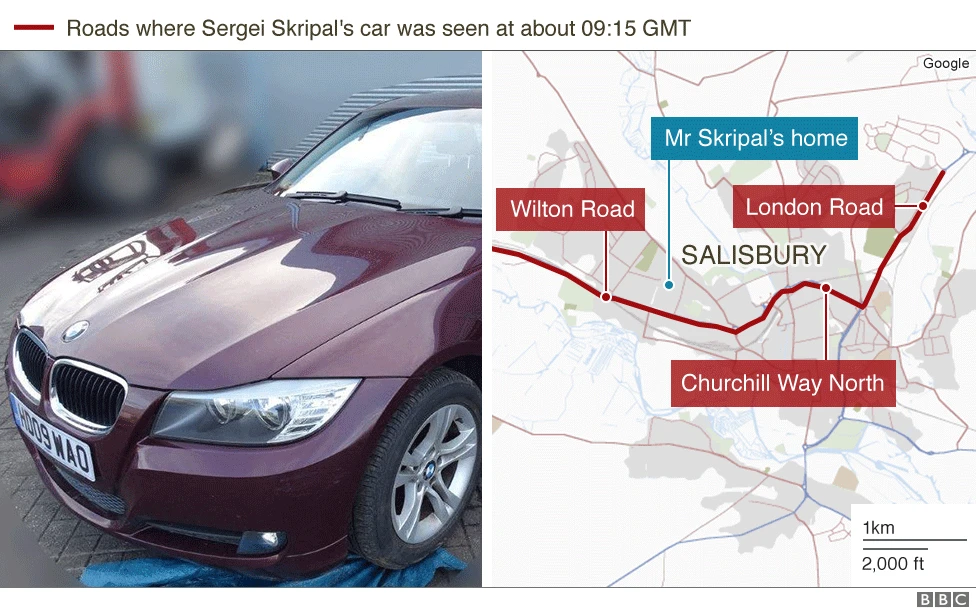
The “car narrative”, meanwhile, originates with a Counter-Terrorism Police report from 5 June 2018. The report reads: “09.15hrs — Sergei’s car is seen in the area of London Road, Churchill Way North and Wilton Road.” This information was repeated in a BBC News report from 27 September 2018 that includes a map indicating Skripal’s car was seen at no less than three locations heading towards London Road that morning. How these sightings were made or recorded is not clear.
There is a cemetery on London Road where the grave of Liudmila Skripal, Sergei’s wife, and the memorial stone for Alexander (Sasha) Skripal, Sergei’s son, are located, and it is evident the UK authorities believed that is where Sergei and Yulia were driving to. In the first edition of The Skripal Files, published in September 2018, Mark Urban wrote: “It became clear to police that the Skripals went out that Sunday morning to visit Liudmila’s and Sasha’s graves at the London Road cemetery, came home briefly and then went out again at about 13.00.”
Four days after the Skripals were taken to hospital, the cemetery was sealed off. This was one of the early, highly visible signs that the authorities were extremely concerned about the risk of Novichok contamination at sites around Salisbury that the Skripals had visited before their collapse. Specialist officers in bright yellow hazmat were shown on Sky News erecting a forensic tent over Alexander Skripal’s memorial stone; The Guardian also reported the full-scale response to the danger of a nerve agent that the Skripals might have unwittingly spread around the cemetery.
This highly visible operation had two problems at its narrative core.
First, the two Russians who the UK accused of contaminating Skripal’s front door on 4 March 2018 didn’t arrive in Salisbury until 11.45 that day, when they were seen on CCTV leaving Salisbury Railway Station. (§3.52) According to the official narrative, therefore, it was impossible for the Skripals to have been poisoned earlier than this, so they could not have been spreading contamination around a cemetery that they were seen driving towards at 09.15.
Second, although there had seemingly been three sightings of Skripal’s car driving towards the London Road cemetery at around 09.15, there was no CCTV or other sightings of the car returning to his house. Mark Urban may have written that the Skripals “came home briefly” — this being when they presumably became contaminated by touching the poisoned front door handle, although Urban glosses over that critical point in the narrative — but there was no evidence to support Urban’s claim that a journey from the cemetery back to the house had actually been made.
The narrative was therefore adjusted so that, instead of going out, the Skripals were said to be at home all morning. An expanded second edition of The Skripal Files was released in September 2019, “revised and fully updated”. The key passage was changed to: “The police initially believed that the Skripals went out that Sunday morning, perhaps to visit Liudmila’s and Sasha’s graves at the London Road cemetery.”
This revised version of events — with the Skripals inside the house all morning — is the version that Hughes used. Like Rowley, the Skripals were not asked to give oral evidence to the inquiry, even by secure video link during its closed, secret sessions, because Hughes said Russia would try to assassinate them again if they did so. (§A8.4) Instead, unsigned written statements were supplied in their names, and these statements both indicated that they did not go out until the early afternoon. (§3.10)
Phone and internet usage records were also supplied to the inquiry to support the UK authorities’ contention that the Skripals had been at the house all morning, while the multiple reported sightings of Sergei’s car at 09.15 were said to have been a single case of mistaken identity originating with one person — a “retired minister” called John Hiles — who appears to have no internet or social media footprint whatsoever.
So: falsely representing the “phone narrative” and the “cemetery narrative” as Russian inventions, Hughes dismissed them on that basis even though they both actually originated from the UK. (§3.11, §3.116) However, “[s]ome of the assertions made… deserve fuller analysis,” he wrote. (§3.117)
3. A BBC report of 4 June 2018 mentioned that Dstl does produce small amounts of chemical and biological agents for research, to help develop effective medical counter-measures and to test systems. Similarly, in interviews, Dstl’s then chief executive did not deny that Novichok could be, or was, produced there (§3.117a)
DSTL (Porton Down) is the UK’s chemical weapons research laboratory, located about eight miles from Salisbury, and the facility where the nerve agent VX was developed in the 1950s. At the time of the Skripals’ alleged poisoning it was involved in a large annual military chemical warfare training operation called Toxic Dagger, a three-week exercise intended to prepare troops for chemical, biological, radiological and nuclear (CBRN) operations. Having commenced in mid-February, Toxic Dagger culminated in early March with a full-scale exercise involving more than 300 military personnel as well as government and industry scientists.
A few days after the Salisbury events, it was announced that DSTL Porton Down would receive £48 million in increased investment to build a new “Chemical Weapons Defence Centre” at the site. “The new centre will have access to all the chemical agents used in weapons — like sarin or the Novichok nerve agent used against Skipral [sic]”, the April 2018 edition of Global Defense Technology magazine reported.
At the time of writing (July 2026) the UK government has announced a further four-year, £580 million investment in DSTL Porton Down, which will include “building a new lab for biological threats, named after NATO co-founder Ernest Bevin”.
At least one of the formulae for the Novichok class of nerve agents was published in a book in 2008, and following the Salisbury incident David Collum, a distinguished professor of organic chemistry at Cornell University, demonstrated that all of his first-year students had the theoretical knowledge to synthesise the toxin after he set it as an exam question.
In noting that Porton Down produces chemical weapons — almost certainly including Novichok — for the purposes of research, the Russian Embassy was not alleging that the chemical weapon supposedly used on the Skripals came from the chemical weapons laboratory just a few miles away from where they were found.
Rather, the embassy was pointing out that the alleged use of Novichok did not in and of itself implicate Russia in the attack on the Skripals, because other parties had the capability to make it.
Another reason the Russian Embassy wanted to make the point that the supposed use of Novichok did not ipso facto implicate the Russian state in the alleged attack on the Skripals is because that is what the UK Prime Minister at the time, Theresa May, said immediately after the incident.
On 12 March 2018, May told Parliament that the Skripals had been poisoned with “a military-grade nerve agent of a type developed by Russia”, adding that “only two plausible explanations” were possible: either the Russian state had carried out the attack itself, or it had somehow lost control of its stockpiles of the nerve agent.
May made no allowance for the possibility that a Novichok-type agent could have been produced independently outside of Russia, and both alternatives she offered involved a degree of Russian state culpability: it was merely a question of whether this culpability was direct or indirect.
But she still offered two alternatives.
The response Hughes gave to the Russian Embassy’s observation that Porton Down and other laboratories around the world were capable of producing Novichok — if they had not already — was dismissive.
“It would be legitimate (and wholly unsurprising) if limited quantities were held in defence and security laboratories internationally, precisely and only for the purpose of making effective any reaction to malicious use by others,” he wrote. (§3.121) “So, purely for the purposes of considering the argument advanced for the alternative narrative, I have considered the theoretical possibility that the nerve agent was available in the UK.”
That was it. No account of this consideration that Hughes supposedly made was offered. As far as Hughes was concerned, nothing more needed to be said about the matter, even though the possibility that the Novichok in Salisbury might not have been deployed by the Russian state had initially been raised by the then UK prime minister. The implication was that such a possibility was absurd, and not worthy of further discussion.
It should be noted that the foreign secretary at the time of the Salisbury incident, Boris Johnson, claimed in an interview with the German media outlet Deutsche Welle on 20 March that “the guy” at Porton Down had told him personally that the Novichok supposedly used to poison the Skripals had been definitively identified as having been manufactured in Russia. Johnson claimed that the Porton Down employee he had spoken with was “absolutely categorical” on this point.
“I asked the guy myself, I said, ‘are you sure?’”, Johnson said. “And he said, ‘there’s no doubt’. So we have very little alternative but to take the action that we have taken.”
That action was expelling 23 Russian diplomats, which the UK did on 14 March 2018. Subsequent expulsions were carried out by nations allied to the UK: nine countries expelled diplomats on 26 and 27 March (US 60; Canada four; France, Germany and Poland four each; Ukraine 13; Australia two; Ireland one; Moldova three).
Johnson’s claim about the source of the Novichok was subsequently shown to be a lie. The head of Porton Down at the time went on Sky News on 31 March and denied that anyone at the laboratory had definitively identified the Novichok as having been manufactured in Russia. But by that time the expulsions of Russian consular staff around the world had been carried out — and Johnson, then the UK’s most senior diplomat and later to become prime minister, never felt the need to address the deception he had used to justify them. The damage had been done.
Theresa May’s early suggestion that the Novichok might not have come from the Russian state itself was also memory-holed and never mentioned again. However, it was not forgotten by the investigative journalist Nick Davies, author of the classic study of propaganda Flat Earth News, who commented that he had not seen any British journalist check a single element of the Skripal story, and that the quality of reporting on the case was as poor as the reporting that Saddam Hussein’s Iraq had WMD.
4. There is said to be no satisfactory explanation for the “extraordinary coincidence” of the presence of Alison McCourt, Chief Nursing Officer of the British Army, at the scene of the Skripals’ collapse, and the fact that this was not publicised until January 2019 (§3.117b)
In what does appear to be a remarkable coincidence, the first responders to the Skripals when they eventually succumbed to the supposed effects of Novichok on a bench in Salisbury included Colonel Alison McCourt — at the time the chief nursing officer of the British Army — and her teenage daughter Abigail.
As we know, the Skripals were apparently exposed to Novichok when they both touched the front door of Sergei’s house on leaving in the early afternoon of 4 March 2018, and it took a couple of hours for the poison to take effect. During this period they drove into Salisbury and, after parking at a supermarket car park, fed ducks on the River Avon with some local boys.
They then went for a drink at a pub, followed by a meal at an Italian restaurant. On leaving the restaurant they sat on a bench in an open air shopping area in central Salisbury, and it was only then that the Novichok they had supposedly touched around two hours before incapacitated them.
Although the unsigned statement presented to the inquiry in Yulia’s name says she began to feel unwell before Sergei, the full onset of effects must have been rapid and near-simultaneous in them both because neither was able to call out to passers-by for help on behalf of the other. The inquiry heard that they remained on the bench for more than 30 minutes before anyone realised they were in any kind of difficulty (source, p21).
Finally, however, Colonel McCourt’s daughter Abigail apparently noticed that they were in distress, and brought this to the attention of her mother. The McCourts both then helped the Skripals as best they could, together with other people who also came to their aid.
About nine months later, in January 2019, Alison nominated her daughter for a bravery award presented by a local radio station, which is how the fact that the British Army’s most senior nurse was one of the first responders to the Skripals at the bench became public knowledge. Understandably, the Russian Embassy remarked on this “extraordinary coincidence”.
Hughes’s reply to this was that, insofar as it was a coincidence, it was not an extraordinary one. “Alison McCourt lived near Salisbury,” he wrote. “There is no reason whatsoever why she should not have been in the city with her husband and children on the day in question and, given her training, every reason why she should go to the assistance of the Skripals… I see nothing remotely extraordinary about her presence.” (§3.121b)
Hughes made two other significant remarks in his reply.
First, he wrote: “It is… extremely improbable that, if there had been some kind of orchestrated event involving [Alison McCourt] and a very dangerous poison, she would have involved her husband and children in close proximity to it.”
Hughes was of course correct here. McCourt clearly did not think the Skripals had been affected by a “very dangerous poison”, or she certainly would not have allowed her daughter to touch them in any way due to the risk of cross-contamination. It was later confirmed that neither of them had been contaminated by deadly nerve agent.
Hughes’s second significant remark apparently related to Alison McCourt’s mental health. “[O]nce there was publicity… after [Alison McCourt had nominated her daughter Abigail] for public service recognition for what she… did to help [the Skripals], that unwanted publicity, plus the injury which she and her daughter sustained did lasting damage to the family’s health, including that of Alison McCourt,” he wrote (§3.121b).
It is grimly comical to see Hughes referring here to “unwanted publicity” for Abigail McCourt, while in the same sentence noting that this publicity was the result of Abigail being nominated for public recognition by her own mother. But more seriously: what injury is Hughes referring to when he states there was “lasting damage to the [McCourt] family’s health”?
As just noted, no-one in the McCourt family suffered physical harm from Novichok cross-contamination after coming into contact with the Skripals. It would instead appear that the injury Alison McCourt suffered was to her mental health. Specifically, it appears it was the response of the authorities in immediate aftermath of the alleged Novichok attack that caused her and her family mental trauma.
Like Charlie Rowley and the Skripals, Hughes excused Alison McCourt from giving oral testimony before the inquiry, so there was no opportunity to ask her about what she witnessed at the bench or how she felt about what happened afterwards. But in a signed statement she wrote: “In the aftermath of the incident I was given inconsistent information and directions by the police… I was told by police that my car did not need to be examined and there was no safety concern and I could continue driving it.
“Then a week after the incident the police turned up at our house at 9pm without warning and confiscated our car keys and returned subsequently with the Army to remove our family car under full ‘bio-hazard’ conditions. I found this extremely distressing as my family and I had been using the car unprotected throughout the intervening period.”
This account of mental trauma caused by the inconsistent approach the authorities took to the apparent danger of cross-contamination echoes that of DS Nick Bailey, a policeman who was the only person other than the Skripals to suffer significant symptoms as a result of the alleged Novichok contamination of the front door. He made a full physical recovery but said the authorities’ response — which included destroying all his family’s possessions — was “heartbreaking” and “confusing”, and he retired from the police force due to ongoing mental issues in October 2020. (§3.75)
We will look at his case and the question of cross-contamination in more detail presently.
5. There is said to be no satisfactory explanation for the presence at Salisbury District Hospital at the time of the admission of the Skripals of “staff trained to deal with nerve agent poisonings” (§3.117c)
As with the suggestion that the Skripals went out to a cemetery on the morning of the day they were allegedly poisoned and the suggestion that they turned off their mobile phones, it is notable that the Russian Embassy would ask why there were medical staff “trained to deal with nerve agent poisonings” at Salisbury District Hospital at the time the Skripals were admitted. It is an unusually specific question that must have been prompted by a specific article or report.
In his response (§3.121c) Hughes flatly denies this was the case. He lists the medics and first responders who were involved, and says there is no suggestion they were a group of specialists trained in the treatment of nerve agent or organophosphate poisoning who were somehow fortuitously on hand. He writes:
There was “one [police] officer with general CBRN training, who was aware from literature (but not of course from personal experience) of possible signs of organophosphate poisoning”; Dr Cockroft, “the consultant initially responsible for the Skripals on Sunday night/Monday morning” who was “also aware, through literature, of organophosphate poisoning in agricultural contexts”; the microbiologist Dr Russell “who had CBRN training” and had “raised with Dr Cockroft… the possibility of nerve agent poisoning, but he did not press him about it”; and Dr James Haslam, who “had no particular CBRN or other relevant training”.
“There was a healthy debate amongst the doctors about what the cause of the Skripals’ acute condition was,” Hughes continues. (§3.121c, v) “The picture does credit to the scientific curiosity of the doctors, but it is far removed from there being a pre-arranged team of nerve agent experts assembled to deal with the Skripals after a staged contamination.”
In interviews with Mark Urban for the BBC shortly after the Salisbury events, the medics at Salisbury District Hospital made it clear there had been no early suggestion that the Skripals had been exposed to a deadly nerve agent — the initial diagnosis and treatment, at least in the initial 24 hours, was opiate overdose (§3.63) — and so they took no special precautions for themselves to guard against the risk of cross-contamination (such as barrier nursing) while treating them.
But Hughes’s response again leaves a question: how did the Russian Embassy get the impression that there had been “staff trained to deal with nerve agent poisonings” on hand at Salisbury District Hospital at the time the Skripals were admitted? It is not the kind of detail that the embassy would simply make up, although Hughes’s dismissal of the point may imply it had done so.
Again it appears that — like the claim the Skripals went to the cemetery early in the morning of the day they were allegedly poisoned, and the claim they turned off their mobile phones for a few hours — it originated with the UK media: specifically in this case a former British Army colonel called Hamish de Bretton-Gordon.
As a former commanding officer of the UK’s now-disbanded Joint CBRN Regiment, de Bretton-Gordon is frequently presented by the UK media as an expert in chemical weapons and military matters such as the conflicts in Syria and Ukraine — but he is given to making claims that could potentially be described as exaggerated, sensationalist or scaremongering.
For example, in May 2015 he said that jihadists returning from Syria to the UK could use a chemical from household fridges to make homemade chemical bombs that would “cause devastation if used in a British shopping centre or on the London underground”, and in September 2015 he suggested the Islamic State in Syria had access to 20 tons of Mustard Gas that it could smuggle into Europe.
In February 2018, less than three weeks before the Salisbury events, de Bretton-Gordon wrote an article for the BBC saying that chemical weapons from Syria represented a threat to the West, and warned that although “Russia and the US have destroyed their chemical stocks… there is speculation that research has been done on new super chemicals many times more potent than nerve agents like Sarin and VX”.
On 7 April 2018, a month after the Salisbury events and three months before Dawn Sturgess died, de Bretton-Gordon was interviewed for an article in The Daily Mail headlined “The Novichok timebomb: Nerve agent used to poison former Russian spy and his daughter was specially designed to take four hours to kill them so their assassins could flee Britain.”
De Bretton-Gordon, the article claimed, “has had access to secret intelligence relating to the poisoning”.
The article’s headline assertion that the Novichok the Skripals were supposedly exposed to had been “specially designed to take about four hours to kill them so their assassins could flee Britain” was abandoned and memory-holed by the UK after Dawn’s death. This was because Rowley said Dawn had been affected within 15 minutes of “spraying” it on herself, and it was central to the UK’s version of events that the Novichok in the Amesbury bottle was from exactly the same batch of Novichok as was supposedly used on Skripal’s front door.
Testimony that the batch was the same was given to the inquiry by witnesses from Porton Down, which had apparently been able to carry out secret tests that other laboratories did not have time to do (§2.16).
This batch match was not confirmed by independent validation or earlier attempts to do so (source, paragraph 12).
Leaving that to one side, a passage from the article from The Daily Mail reads: “Completely by chance, doctors with specialist chemical weapons training were on duty at the hospital when the victims were admitted. They treated Sergei and Yulia Skripal with an atropine (antidote) and other medicines approved by scientists from Porton Down, the government’s top secret scientific research laboratory.”
It seems almost certain that de Bretton-Gordon was the source of this claim. In August 2018, he gave an interview to CTC Sentinel, the magazine of the Combating Terrorism Center at West Point, the United States military academy in New York. In the course of the interview he made various sensational claims, such as the claim Syrian government forces were “mixing sarin with chlorine… and putting it into hand grenades”, and that there was a risk of “a drone with… very pure chlorine on it crashing into a big [US] sporting stadium with… 80,000 people in it”.
During this interview he was also asked about the Salisbury events and how the Skripals survived exposure to what was said to be an incredibly lethal nerve agent. He told the CTC Sentinel: “The survival of the Skripals was down to a huge amount of luck. Salisbury is very near to the British CBRN research center at Porton Down. There were two doctors on duty who had just done their CBRN course at Porton Down who very quickly thought it was nerve agent. So they were pumped full of atropine [a treatment for organophosphate poisoning].”
It is these reports that are the source of the Russian belief that “staff trained to deal with nerve agent poisonings” were on hand at Salisbury District Hospital at the time the Skripals were admitted.
However, as we have seen from Hughes’s report and the testimony of the hospital staff, not only was it untrue that “there were doctors on duty [at the hospital] who had just done their CBRN course at Porton Down”, but it was also untrue that the doctors at the hospital “very quickly thought it was a nerve agent”.
As Hughes writes: “At the hospital, the initial working diagnosis was of opiate poisoning, which was the obvious first hypothesis… Salisbury had at the time experienced a considerable level of recreational opiate abuse and consequent poisoning, not infrequently manifesting itself in the central area where the Skripals were found”. (§3.63)
It should be added that the initial hypothesis of the police, paramedics and doctors treating Dawn Sturgess was also that she had taken an opiate overdose, possibly the powerful synthetic opiate fentanyl.
This was partly because Charlie Rowley was a drug user known to the police. Charlie and Dawn were described by the police as “two well-known drug addicts” (source, p22), although the Sturgess family strongly rejected the suggestion that Dawn took hard drugs.
But it was also partly because one of the police officers who attended Rowley’s Amesbury flat after Dawn collapsed there had also been a first responder two years before when Rowley’s previous girlfriend, Natasha Davis, had died of an opiate overdose in his presence (source, p122).
When toxicology analysis was carried out on samples of Dawn’s blood that were taken after she was admitted to hospital, fentanyl was found to be present. However, the pathologist Professor Guy Rutty told the Dawn Sturgess Inquiry he had not been informed of the levels at which it was present (source, p40).
One of the hospital’s ICU consultants, Dr Stephen Jukes, told the inquiry that he had given Dawn fentanyl in hospital when she was put on mechanical ventilation (source, p167). This is notable because Dawn would not have needed pain relief as she was already profoundly unconscious due to catastrophic brain damage, and because fentanyl would be counter-indicated by a working diagnosis of fentanyl or opiate overdose.
These two factors made it impossible to determine if Dawn had taken fentanyl before she was taken to hospital.
6. It is said that, in an article published on 8 April 2018, the then Foreign Secretary, Boris Johnson, misrepresented or misinterpreted remarks made in 2010 by Vladimir Putin, who was Prime Minister at the time, saying that he had made a televised threat that “traitors” would “kick the bucket ” and “choke”, whereas in fact Mr Putin had said that Russia did not use assassination, whilst “traitors” would “kick the bucket ” of their own accord and “choke” on their “thirty pieces of silver ” (§3.117d)
In the same article, the then Foreign Secretary was said to have misrepresented or misinterpreted Russian law in saying that it “allows the assassination of ‘extremists’ overseas”, whereas in fact it was asserted that the law permits only the sending of formations of armed forces to combat terrorists and their bases abroad (§3.117e)
The article the Russian Embassy is referring to is an article first published in The Sunday Times, headlined “Boris Johnson: Russia’s torrent of absurdity is soaked up by an ‘infantile’ Corbyn” and then republished on the UK government website, with several passages removed, as “Only Russia could have committed this crime: article by Boris Johnson”.
Hughes largely agreed with the points that the Russian Embassy made in response this article, but said they had no bearing on the question of whether or not the Salisbury incident had been staged by the UK.
Johnson had written: “Russia has an obvious motive for targeting Sergei Skripal. In the year that Skripal moved to Britain, President Putin made a televised threat that ‘traitors’ would ‘kick the bucket’ and ‘choke’”.
Hughes responded: “Mr Putin’s public remarks in 2010 about ‘traitors’ did not amount to an assertion that they would be or should be assassinated. […] [T]hey were contemptuous of those so described and suggested that they would come to a bad ending, but the words used did not carry the implication put upon them by the then Foreign Secretary’s interpretation, which overstates matters. I do not, however … consider that analysis … of Mr Putin’s remarks provides any help at all on whether the Salisbury event was staged by the UK.” (§3.121d)
Johnson also wrote: “The Russian Duma has actually passed a law that allows the assassination of ‘extremists’ overseas.”
Hughes responded: “This point [that Johnson misrepresented Russian law] is partly correct. Russian law… does not… authorise assassination, but it… authorises the President to permit the deployment of “sub-divisions of special operations federal security service organs” against terrorists and/or their bases outside Russia, “in order to eliminate a threat to the security of the Russian Federation”. It is plainly possible that that could be taken to include a strike against an individual regarded by the Russian authorities as a threat to the country’s security. But again, I do not consider that close interpretation of the terms of foreign legislation, nor of the Foreign Secretary’s non-lawyer’s comments upon it, assist in the resolution of the question whether the Salisbury event was staged by the UK.” (§3.121e)
It is interesting to see what Johnson wrote in the passages that were cut from The Sunday Times article before it was republished by the UK government as an official document.
In the edited version, Johnson accuses the Kremlin of “running a cover-up” and suggests that the fact the Russian Embassy had come up with many alternative theories to explain what had happened to the Skripals was in itself evidence of Russian guilt. He suggests that the fact nations allied with the UK had expelled Russian diplomats from their territories in solidarity with the UK was also evidence of Russian guilt. He then invokes then-Prime Minister Theresa May’s statement from 14 March saying that there is “no alternative conclusion other than that the Russian state was culpable for the attempted murder”.
Concluding, Johnson mocks Russia for asking to be included in the investigation into the Salisbury events that was being undertaken by the Organisation for the Prohibition of Chemical Weapons (OPCW), which he likens to “a drunk driver insist[ing] on the right to join the police investigation into himself”.
In the unedited version, Johnson has several paragraphs attacking Jeremy Corbyn, the leader of the opposition Labour Party at the time. Corbyn, he writes, “cannot bring himself unequivocally to say that the Russian state was responsible” and says: “I repeated [Theresa May’s] assessment [that the Russian state was culpable for the attempted murder of Skripal] in the interview I gave to the German media last month, an interview that Jeremy Corbyn claimed bizarrely was not backed up by the evidence”.
The interview with German media Johnson refers to, of course, is the Deutsche Welle interview he gave on 20 March when he lied about Porton Down having established that the Novichok in Salisbury was made in Russia — and it was not Corbyn who had initially said that this claim was not backed up by the evidence, but the head of Porton Down.
Johnson’s lie caused embarrassment for the UK Foreign Office, which had repeated his claim about the Russian provenance of Novichok and was subsequently obliged to delete its statement on Twitter when Porton Down denied it, but this was not something Johnson ever acknowledged.
Johnson’s original article in The Sunday Times continues: “Remember Porton Down’s verdict that the nerve agent required ‘extremely sophisticated methods to create, probably something only in the capabilities of a state actor’. This effectively rules out Jeremy Corbyn’s hypothesis that the Russian mafia was somehow responsible.”
These, too, were false statements. As noted, Cornell’s Professor Collum demonstrated that his first-year chemistry students had the capability to theoretically synthesise Novichok. More significantly, it was Theresa May who first suggested the Russian state might have somehow lost control of its stockpiles of the nerve agent and allowed them to fall into the hands of criminals. As already noted, this was a suggestion she quickly abandoned, without any explanation for why she had done so.
7. Russian requests for consular access to the Skripals were not granted (§3.117f)
The right of consular officials to visit or have access to a national of their country who is in prison, custody or “detained in any other manner” in a different country or “sending State” is provided for by Article 36 of the Vienna Convention on Consular Relations (1963). The key passage is this:
Article 36(1)(c): “Consular officers shall have the right to visit a national of the sending State who is in prison, custody or detention, to converse and correspond with him and to arrange for his legal representation. They shall also have the right to visit any national of the sending State who is in prison, custody or detention in their district in pursuance of a judgement. Nevertheless, consular officers shall refrain from taking action on behalf of a national who is in prison, custody or detention if he expressly opposes such action.”
The final sentence of this passage is what Hughes relied on in his response to the Russian Embassy’s complaint that they had not been granted consular access to either Sergei (a dual British-Russian national) or Yulia (a Russian national only) Skripal in the aftermath of their alleged poisoning.
“All the evidence shows that neither Sergei nor Yulia Skripal wished to avail themselves of consular assistance from Russia,” Hughes wrote. (§3.121f) “The idea that [Sergei Skripal] wanted consular assistance from those who had convicted and imprisoned him is fanciful.”
Given the testimony that Hughes had heard over the course of the Dawn Sturgess Inquiry hearings, for him to suggest that it is “fanciful” Skripal might want consular assistance — and dismiss such an important principle of international law on that basis alone — is extraordinary.
As we have noted, Hughes failed to speak to Skripal personally, having ruled that any appearance by either Sergei or Yulia, even by secure video link during the inquiry’s secret sessions, would have exposed them to further risk of assassination by the Russian state.
But putting this to one side, Hughes was aware that Skripal’s feelings around Russia and President Putin were complex. Hughes knew that Skripal regarded himself as a Russian patriot, and that he had mentally justified his betrayal of state secrets to the UK by convincing himself that they related to an entity that no longer existed: the Soviet Union.
In a passage from The Skripal Files — referred to in inquiry documents — Mark Urban writes that “[Skripal] is, or was at least when we were talking in 2017, an unashamed Russian nationalist, enthusiastically adopting the Kremlin line in many matters”. Skripal was described as “cheer[ing] on Vladimir Putin’s annexation of Crimea”.
According to Urban, Skripal viewed Ukrainians as “incapable of leadership” who were “simply sheep who need a good shepherd [in Russia]”. Urban also writes that “Skripal would… watch a good deal of television, devoting many hours to Pervy Kanal — Russia’s First Channel… known for following the Putin line closely in its news coverage.”
More than this, Hughes knew that the unsigned statement supplied to the inquiry in Skripal’s name said he “had received a Presidential pardon and [believed he] was a free man with no convictions under Russian law”. He also knew that transcripts of police interviews with Yulia Skripal from 2018 included her saying things like: “When [Sergei] was released from prison, officially all this case was erased so he able to travel back to Russia when he wants so everything is like he’s a new person so, like he has no convictions, had no convictions at all, so he’s clean and that’s why he told me that FSB, other Russian agencies should be fine with him.” (source, p14)
Skripal apparently told Mark Urban that he was scared of President Putin, and was reportedly very watchful. Nevertheless he had apparently refused to take basic security precautions — such as CCTV — at his home (source, par 27). His children Yulia and Alexander had been free to travel from Russia to see him for years, and there were accounts that Skripal had been visiting the Russian embassy in London because he was hoping to secure permission to return to Russia to visit relatives including his mother, who he called regularly before his alleged poisoning.
There were even accounts that Skripal had not wanted to be part of the 2010 spy swap that brought him to Salisbury in the first place, and he had instead wanted to serve out his time in prison so that he could remain in Russia afterwards, but the UK government had apparently insisted he was part of the exchange.
With all this information before him, Hughes nevertheless presumed to speak for Sergei Skripal without having spoken to him himself, ruling that Skripal continued to “expressly oppose” a visit from — or any communication with — Russian consular officials under the terms of the Vienna Convention, even though six-and-a-half years had passed.
Hughes’s treatment of Yulia Skripal’s case was similar, but even worse.
The evidence showing that Yulia did not wish to avail herself of Russian consular assistance “was particularly true of Yulia, who said so publicly, soon after recovering sufficiently to be discharged from hospital”, Hughes writes, footnoting a document that was presented to the inquiry to support his assertion (source, paragraph 122; §3.121f).
The paragraph from this “open report”, created in October 2024 by the Metropolitan Police Counter Terrorism Policing Unit for the Dawn Sturgess Inquiry, reads: “On 23 May 2018, Yulia Skripal gave a short video interview to Reuters and provided the press with a handwritten statement.”
The statement that Yulia gave an “interview” to Reuters is false and highly deceptive, suggesting that Yulia answered questions from the press and was able to speak freely about what had happened to her. This was untrue. Yulia merely read out a statement for the cameras, after which she was taken away, never to be seen again.
It should be noted as an aside here that the UK authorities clearly believed their ability to protect Yulia from further attacks from Russian assassins was good enough for her to be produced for the public on this one occasion. Why Hughes decided that the risk to Yulia had become too great for him to speak to her six years later is not something he explained.
But even in the context of the highly controlled conditions under which Yulia was briefly displayed for the international media in May 2018, the statement she read out undermined Hughes’s determination that she did not want consular assistance.
In her statement she said: “I’m grateful for the offers of assistance from the Russian Embassy but at the moment I do not wish to avail myself of their services.”
She also said, “in the longer term I hope to return home to my country”.
By saying “at the moment”, Yulia was clearly reserving the opportunity to avail herself of the Russian Embassy’s assistance at some point in the future. And what did Yulia mean when she said she wanted to return home to her country “in the longer term”? She made this statement in May 2018. Hughes then decided that she still held the same position with regard to Russian consular assistance six-and-a-half years later, apparently without having communicated with her in any way.
Was such a passage of time not “the longer term”?
With no regard for Yulia’s current situation and welfare — whatever that may be, and there is no suggestion he knew — Hughes ignored that part of Yulia’s statement, while claiming other parts still reflected her current view.
And yet this was not even the worst aspect of Hughes’s response to Yulia Skripal as an individual and a citizen of the Russian Federation: a woman who had seemingly become innocent collateral damage in an alleged assassination attempt on her father.
When the Skripals were admitted to hospital, Hughes writes, “[n]either could breathe unaided, and both were experiencing multiple organ dysfunction and profound compromise of the central and peripheral nervous systems”. (§3.62) “They were very nearly killed, and the injury done to them, short of that, was enormous.” (§3.69)
As we have seen, contrary to the claims of Hamish de Bretton-Gordon, the Skripals were not treated by doctors who by strange good fortune had recently completed CBRN training at Porton Down. Instead they were diagnosed and treated for a suspected opiate overdose in the initial 24 hours of their hospitalisation. (§3.63)
But de Bretton-Gordon’s false statements about the hospital’s early diagnosis and response had a foundation in something he knew to be true: that if people are admitted to hospital with “profound compromise of the central and peripheral nervous systems” that is genuinely due to nerve agent poisoning, then a swift and accurate diagnosis followed by aggressive treatment is essential if the victims are to stand any chance of survival.
As we have noted, this did not happen. The Skripals did not receive a swift and accurate diagnosis, although this was in no way the fault of the medical staff at Salisbury District Hospital. There is an overlap of symptoms, but the treatment for opiate overdose is not by some miracle also the correct treatment for nerve agent poisoning.
In his media appearances, de Bretton-Gordon had described Novichok as a “super-weapon of mass destruction”. He told the Forces News website that Novichok was “possibly the most toxic man-made chemical ever produced”. But if this was true — and Novichok was genuinely more deadly than a nerve agent like VX — then even with correct treatment, severe and permanent injury to the Skripals should have been certain, given that they both received a dose sufficient to cause them to collapse.
As a result de Bretton-Gordon was caught between the reality of the Skripals’ recovery and the claims he had made about the lethality of the poison they had allegedly been exposed to.
Although they were not “nerve agent experts” like de Bretton-Gordon, the doctors at Salisbury District Hospital who were treating the Skripals were aware from medical literature of the extreme toxicity of weaponised organophosphate neurotoxins such as VX. For this reason, when they were informed by Porton Down that their early diagnosis of opiate overdose was not correct and the Skripals had supposedly been exposed to a nerve agent in the VX class, they expected the Skripals to die.
However, the Dawn Sturgess Inquiry heard testimony that confounded these expectations, and introduced questions about the nature and purpose of the treatment Yulia, if not Sergei, received. This testimony in turn raised questions about the character of the inquiry and the role Hughes carried out within it, exposing a tension between the clinical reality and the official story that would have caused the proceedings to collapse if Hughes had not been willing to overlook the implications of what he was told.
On day nine of the Dawn Sturgess Inquiry, the ICU consultant at Salisbury District Hospital who had been on duty at the time the Skripals were admitted, Dr Stephen Cockroft, gave oral testimony. He told the inquiry that, just four days after she was hospitalised, Yulia unexpectedly recovered consciousness during what is known as a “sedation hold” — a reduction in the sedation she was receiving while she was on a ventilation machine. Such sedation holds are common practice in ICUs and are carried out daily or even more frequently, as they are known to improve outcomes and help clinicians evaluate the physical and neurological health of patients who are being kept in a state of unconsciousness, or what is sometimes called a medical coma. (§3.62)
Yulia did not simply recover consciousness after her sedation was reduced: she exhibited a high level of neurological function. She became panicked, and attempted to get out of her hospital bed even though she was intubated and had cannulas in her veins. Witnessing this, Dr Cockroft said he was “gobsmacked” because he believed Yulia would have suffered profound and permanent brain injury.
“This was a girl I thought would never move again,” he told the inquiry. “I never thought she would be capable of having a conversation. I was quite convinced she had suffered catastrophic brain damage and I couldn’t believe that she could be as neurologically intact as she obviously was.”
Because she was unable to speak due to intubation, Dr Cockroft communicated with Yulia by asking her to blink yes or no to questions he asked her. He discovered by doing so that Yulia believed she had been sprayed with a substance while she and Sergei were in the restaurant, rather than by touching a poison that had been put on the door handle of Sergei’s house an hour or so before they went out for lunch. (source, par77)
Hughes dismissed all this, saying Dr Cockroft had asked Yulia “leading questions” that were “clearly inappropriate” and concluding that “the exchange under sedation provides no reliable evidence at all about how Yulia Skripal was exposed to the Novichok” (§3.89)
This is a decision that contrasts with his acceptance of the testimony of Charlie Rowley about the Novichok perfume bottle — even though Rowley had no memory of finding this bottle due, at least in part, to his addiction to alcohol and heroin.
Dr Cockroft’s discovery that Yulia possessed high neurological function challenged Hughes and the Dawn Sturgess Inquiry at a fundamental level.
From a clinical point of view, this event should mean placing the patient on a Bispectral Index monitor and using an Electroencephalogram to evaluate brain function. ICU protocol should also lead clinicians to continue with sedation holds, and — if the patient continues to respond well — remove them from ventilation as soon as safely possible.
Some of these procedures may have been carried out, but there is no way of knowing. All we know is that Yulia said she was under sedation for almost three weeks in total, and made no mention of waking up after just four days when she gave her brief public statement in May 2018.
Dr Cockroft was reprimanded by the clinical director of Salisbury Hospital after discovering that Yulia had not suffered severe neurological injury due to her alleged exposure to Novichok, and for asking her questions about what had happened. He was immediately removed from the ICU rota. The Skripals were placed under the exclusive care of a different doctor, and Cockroft was threatened with a charge of serious misconduct if he spoke to any of his colleagues about what he had witnessed.
Dr Cockroft was allowed back on to the ICU rota after the Skripals were discharged but shortly afterwards resigned, ending a distinguished 25-year career at Salisbury District Hospital (source, par12).
Hughes was presented with evidence that Yulia had not suffered severe damage to her nervous system only a few days after she was admitted to hospital, even though she had supposedly been severely injured by the most deadly nerve agents in existence. The implications in terms of the events he was supposed to be investigating were profound.
It also seems Yulia was not allowed to wake up again for two weeks following her initial recovery after just four days. Was this medically necessary? Was Yulia granted full agency, or made aware of the offer of Russian consular assistance that had been extended to her at this point?
Could Yulia be being held against her will?
Hughes ignores this question. He merely wrote that “[f]or much of [the Skripals’] time in hospital, they were maintained in a coma”. (§3.62)
8. Russian requests for access to samples from the patients or elsewhere were not granted (§3.117g)
The widely-mocked idea that the Russian state should be allowed to test blood samples from the Skripals was one of the most significant aspects of the Salisbury incident. Jeremy Corbyn, then leader of the Labour Party, was the only prominent British politician who suggested the idea should be taken seriously.
On 14 March 2018, Corbyn told the House of Commons: “The Prime Minister said on Monday: ‘Either this was a direct act by the Russian state…or the Russian Government lost control of their potentially catastrophically damaging nerve agent and allowed it to get into the hands of others.’ Our response must be decisive, proportionate and based on clear evidence. If the Government believe that it is still a possibility that Russia negligently lost control of a military-grade nerve agent, what action is being taken through the OPCW with our allies?”
Corbyn continued: “Has the Prime Minister taken the necessary steps under the chemical weapons convention to make a formal request for evidence from the Russian Government under article IX(2)? How has she responded to the Russian Government’s request for a sample of the agent used in the Salisbury attack to run their own tests? Has high-resolution trace analysis been run on a sample of the nerve agent, and has that revealed any evidence as to the location of its production?”
As we have seen, trace analysis on the nerve agent run at Porton Down was unable to produce any evidence about the location of the nerve agent’s production, although then Foreign Secretary Boris Johnson would lie about this very point just six days after Corbyn’s question to Prime Minister Theresa May — a lie that justified the mass expulsion of hundreds of Russian diplomats from embassies around the world.
And as we also know, May never returned to her suggestion to the House of Commons that the Russian state might not have been directly responsible for the poisoning of the Skripals — a striking bit of memory-holing.
The “article IX(2)” Corbyn was referring to is Article IX of the Chemical Weapons Convention (CWC), which establishes mechanisms for consultations, co-operation and fact-finding among States Parties [states that have signed the CWC, which include Russia and the UK] in cases of alleged chemical weapon use or compliance concerns.
The relevant passage is this:
Each State Party has the right to request clarification from another State Party on any situation which may be considered ambiguous or which gives rise to a doubt about the compliance of that State Party with this Convention. The requested State Party shall provide, as soon as possible but no later than 10 days after the receipt of the request, the clarification sought.
It is under the broad definition of “clarification” that the Russian Embassy on 13 March 2018 “demand[ed] that samples of the chemical substance to which the British investigation is referring be provided to Russian experts for analysis within the framework of a joint investigation”.
This demand was widely mocked in the UK media — as well as by many UK politicians.
After Corbyn questioned May about the Salisbury events in the House of Commons, the BBC Photoshopped his face onto a dark red background of Red Square and darkened his cap to make it look like a traditional Russian ushanka hat. The BBC then used this as a backdrop graphic that evening on its flagship current affairs programme Newsnight.
Hughes, while not adopting the puerile posture of the BBC or the mocking tone of the UK media, took the same attitude: that the Russians were guilty — or at least the evidence pointed to Russian guilt— and therefore the idea that an accused party should be allowed to actually see the evidence their accuser claims to have against them is risible.
Foundational principles of justice such as the presumption of innocence or transparency of evidence were, in Hughes’s judgment, meaningless in cases like this. “Given that there were, at the least, grounds for suspecting Russian involvement in the poisoning of the Skripals, it is not surprising that access to the samples, which would entail the possibility of interference with or misrepresentation of them, should not be given,” he wrote. “The best evidence of the information to be derived from the samples is the independent analysis of them by the OPCW.” (§3.121g)
In applying the assumption of guilt to justify the UK’s refusal to supply the Russian state with biological and environmental samples taken from the Skripals and the front door handle of Skripal’s house, Hughes was overlooking the methodology that the OPCW — the international chemical weapons watchdog known as the Organisation for the Prohibition of Chemical Weapons — employs to carry out analysis in cases like these.
This involves two approved laboratories receiving samples in secret, with neither of the laboratories involved in the testing process knowing which other approved laboratory has also been asked to test a split of the same samples. Once they have carried out their analysis, these laboratories return their results to the OPCW where they are compared and, if they are found to match, a definitive finding can be announced. Such “double-blind” testing is well-established scientific methodology that Hughes should have been aware of.
But in the Salisbury case, no fewer than four OPCW laboratories were involved in the testing process — two analysing the biological samples from the Skripals, and two from the door handle. This was, then, in some sense a “quadruple blind” process designed specifically to eliminate the possibility of error or fraud: or what Hughes called the potential for “interference with or misrepresentation [of]” samples.
This “interference or misrepresentation” is what Hughes was suggesting Russian laboratories would attempt, and that is why he said such an opportunity “should not be given” to the party he believed to be guilty. However, the OPCW methodology would have made it impossible for Russian laboratories to doctor samples supplied to them. Had they attempted to do so they would have had to explain why no less than four OPCW laboratories had produced different results.
None of this context was offered by the BBC at the time it was Photoshopping Corbyn to look like a Soviet agent on Newsnight. Instead the British establishment — the government and its media channels — united to pour scorn on the suggestion that those who are accused of a crime should be allowed to examine the evidence that their accuser claims to have against them.
The Russian state subsequently alleged that leaked information showed one of the OPCW laboratories testing the Skripals’ blood samples had found they contained the precursor chemicals of a non-lethal, hallucinogenic incapacitant known as BZ, the effects of which can last for about four days. The OPCW responded that this had been deliberately introduced to the samples as a control substance.
Hughes saw no reason to question why the OPCW would add evidence of a military-grade hallucinogen to the Skripals’ blood samples after they were taken (§3.119) even though he knew that Sergei was “chanting incomprehensibly” when he was found (§3.17) and witnesses had described him as staring at the sky and making strange gestures with his hands.
9. It was obvious that there must have been a CCTV camera recording Sergei Skripal’s house, but its product had not been made available (§3.117h)
The response Hughes offers to this point is characteristically curt. “There was no CCTV outside (or inside) the Skripals’ home,” he writes. (§3.121h) He makes no further comment.
Not only was there no CCTV at Skripal’s house, but the inquiry believes the two Russian secret agents approached the building during a period when they disappeared completely from Salisbury’s wider CCTV network. The closest the secret agents were seen to Skripal’s house on CCTV was by cameras at a petrol station about half a kilometre from where he lived, after which they entered the first CCTV “black hole”: a 16-minute period when they are supposed to have walked into the cul-de-sac where Skripal lived and used their fake perfume bottle of Novichok to contaminate his front door while he and Yulia were inside.
As we have noted, the reason there was no CCTV on Skripal’s house was because he had apparently refused to have it installed when given the opportunity to do so. If this is true, the question becomes: why would someone in his position not want to take such simple security precautions? Domestic CCTV systems were already common in 2018 and quite unremarkable, as were other basic security systems such as house alarms and motion activated security lights, neither of which Skripal had either.
The unsigned statement that was supplied to the inquiry in Skripal’s name contains remarks that are strangely at odds with his comment delivered to Mark Urban that he was scared of Putin, and that he felt he still possessed “top secrets” that were “really dangerous for Russian special services”.
Skripal had apparently been offered the opportunity to change his identity when he arrived in the UK but chose not to do so because he wanted to maintain his relationships with his family back in Russia. Hughes defended this decision, saying “Sergei Skripal was not of a character readily to adapt to [changing his identity, which could]… only have been accomplished with his consent, and he plainly would not willingly have accepted [it]. (§6.29)
And as we have seen, Skripal seemingly believed he was a free man under Russian law having received a presidential pardon, and his children had certainly been able to travel to visit him in Salisbury from Russia. Yulia even told UK police that she believed her father was free to return to Russia “when he wants” (source, p14).
Skripal apparently felt the spy swap protocol that had led to his release from prison and retirement in the UK would be respected by the Russian state, and he would be left alone — and indeed he was left alone for eight years.
However, the inquiry also heard that Skripal had recently “re-entered the [espionage] game” (source, p16) and was undertaking “work with the United Kingdom and other western intelligence and military agencies that was directly contrary to Russia’s malign global interests, including exposing Russian agents, passing secret information abroad and providing briefings on Russia to foreign intelligence agencies… in the period shortly before he was attacked”. This was presented as the motive for the Russian state to make an assassination attempt against him.
This is the strangely contradictory information and testimony that Hughes heard about Skripal’s sense of personal security living in Salisbury, and the threat Skripal believed he was living under or could have taken reasonable steps to mitigate. But the specific rationale Skripal provided in his unsigned statement for not having CCTV on his house was perhaps the strangest and most contradictory testimony of all.
“CCTV was recommended but I declined this because I did not want to make my house conspicuous or live under surveillance,” his statement reads.
Who does Skripal imagine would be watching him if he had installed CCTV at his home? These systems watch the outside of houses, not the people inside them. When such CCTV systems are installed in homes or business premises, the owner controls who has access to the recordings.
And how would CCTV system outside Skripal’s house make it conspicuous? That they are a visible deterrent is to a large extent the point of these cameras.
The rationale is bizarre and, under Skripal’s circumstances, strains credulity to the extreme.
But this bizarre rationale was merely a taster for what was to come. Hughes returned to the CCTV question later in his report, presenting a cluster of circular arguments that made the suggestion Skripal didn’t want a camera outside his house because it might be “conspicuous” seem reasonable and well thought through.
“It is clear that this attack showed considerable determination and was expected to stand as a public demonstration of Russian power,” Hughes wrote. (§6.37) “Attackers willing to run the risk of being seen approaching the front door by the occupants or by neighbours… were not likely to be deterred by cameras, hidden or otherwise, if their plan was to be on a plane leaving the country the same evening.”
Hughes’s assertion that “[a]ttackers willing to run the risk of being seen approaching the front door by the occupants or by neighbours… [are] not likely to be deterred by cameras” is a textbook example of the question-begging fallacy, a form of circular logic by which someone who makes a claim assumes the truth of their claim.
There is no evidence that the alleged attackers ran the risk of approaching the front door. This is because they were not seen by the occupants or neighbours. But Hughes treats an unproven allegation — that the Russians contaminated Skripal’s door, even though they weren’t seen doing so — as established fact, and then uses this “fact” to claim that the absence of evidence of the two Russians doing what he says they did isn’t important.
Hughes’s logic works like this.
- We believe the two Russians contaminated the door; therefore
- They approached the door; therefore
- They approached the door despite risk of being seen; therefore
- They were willing to risk being seen; therefore
- CCTV wouldn’t have deterred them; therefore
- The absence of CCTV doesn’t matter.
Although, as we know, Hughes has suggested that the two Russian secret agents had acted to mitigate the risk of being tracked while on their alleged assassination mission — by turning off their mobile phones when they arrived in Salisbury, for example — he generally characterised them as having a bizarre and cavalier attitude to the risks they were taking, including the extreme risk to their own health presented by handling a lethal nerve agent, apparently without protective equipment.
This is perhaps clearest in his suggestion that the two secret agents went into a public toilet in Salisbury after contaminating Skripal’s door and took apart their fake perfume bottle of nerve agent there, removing the pump dispenser cap from the bottle. They then supposedly place the two parts of the nerve agent coated bottle into a presentation box, and sealed it in plastic using a portable heat sealer that they had brought with them. (§4.71)
This near-suicidal manoeuvre on the part of the two Russian secret agents represents pure speculation on the part of the inquiry. It was inserted into the narrative to explain the fact that Charlie Rowley had said during an interview with ITV News in July 2018 that the bottle he supposedly found was in two parts inside a sealed box.
Not only this, Rowley said he had spilled Novichok on his hands in the process of assembling the bottle before he gave it to Dawn. His survival was attributed to the fact he said he had washed his hands under the tap (source, p4).
The lead counsel to the Dawn Sturgess Inquiry, Andrew O’Connor KC, suggested that, after taking the bottle apart in a public toilet and sealing it in a presentation box using their portable heat sealer, the two secret agents then almost immediately dumped the package in a bin, where Rowley supposedly found it later (source, p165).
All this allegedly occurred during the second “black hole” in the CCTV of the secret agents’ movements around Salisbury — a 33-minute period when they once again vanished completely.
10. There was an inexplicable lack of adverse reaction in any of those who attended to the Skripals at the bench (§3.117i)
We have noted that Colonel Alison McCourt and her daughter Abigail were not cross-contaminated by Novichok after coming to the aid of the Skripals at the bench. There was also no cross-contamination of Dr Helen Ord, a medical doctor who was passing by and attended to Yulia in particular. No members of the public who also came to help were contaminated either.
The police and paramedics who responded to the Skripals were unaffected, and the medics at Salisbury hospital who treated them believing they had taken an opiate overdose were not contaminated. None of the bar or restaurant staff who handled the glasses, plates or utensils that the Skripals touched with their contaminated hands were affected.
The ducks that the Skripals fed with bread from their contaminated hands were unharmed, as were the boys who joined them: although it seems the deputy chief of the CIA may have lied to President Trump about this, falsely claiming that ducks were killed and boys were injured — and showing him photographs of some kind — in order to persuade him to join in with the mass expulsion of Russian diplomats from embassies around the world on 26 and 27 March 2018.
Who, then, does Hughes say actually was contaminated at the bench? In his response, he writes that there was “serious injury” to “DS Bailey, and … lesser but significant [injuries] suffered by PC Bell, Alison McCourt and her daughter, and VN005”. (§3.121i)
As we have seen, Colonel McCourt and her daughter were not affected by Novichok but by subsequent mental trauma relating to the authorities’ response. DS Bailey was allegedly affected by Novichok after being exposed at Skripal’s house, as was PC [Oliver] Bell, “who had been the guard posted outside Sergei Skripal’s house … [and who later] experienced twitching and pain in one eye”. (§3.76) Bell “was … taken that night to the hospital [but was] not detained”. VN005, the code name of another policeman “who [also] went into the house … experienced a complete loss of sensation in a finger for several days afterwards”. (§3.77) VN005 went to hospital two days later, but he was told a blood test was unnecessary and sent home.
This means that not one of the people Hughes mentions in reply to the Russian Embassy’s question about “an inexplicable lack of adverse reaction in any of those who attended to the Skripals at the bench” were affected by Novichok at the bench: Bailey, Bell and VN005 were all apparently affected by Novichok at Skripal’s house, and the McCourts were not affected by Novichok at all.
The explanation Hughes offers for the complete lack of cross-contamination among the people who were at the bench is that “the risk of person-to-person spread is much less than the hazard of contact by the first person with the poison” (§3.121i). This was contrary to the claims of Vil Mirzayanov, a Soviet scientist who had apparently helped to develop Novichok before defecting to the US, and who had written the book that included a formula for it. Mirzayanov said that “trace contamination [presented a risk] to hundreds of members of the British public who may have been in the vicinity of the attack”.
Many members of the public did in fact attend Salisbury hospital believing they had been affected by Novichok. Mainstream outlets such as Channel 4 reported that “the Novichok poisonings in 2018 resulted in 87 people going to A&E”, while omitting the fact that none of these 87 people were affected by anything other than the public anxiety Channel 4 was helping to cause.
Something more needs to be said about DS Bailey. Like PC Bell and VN005, he went to hospital after they had conducted a search of Skripal’s house on the Sunday night, initially going to A&E on Monday afternoon because he “wasn’t feeling right”. Like both PC Bell and VN005 he was given the “all clear” by the hospital and sent home (source, p79). However he returned the following morning after a night of fever and hallucinations, and was then hospitalised for 17 days before being discharged.
Unlike the Skripals, Bailey was not sedated or put on ventilation, and he said he was “conscious the whole time” of his hospital stay. Reports of his condition and prognosis varied, with the narrative changing over time to suggest he was far sicker than he was originally reported to be. Outlets such as The Independent and The Mirror reported that he was “well” and “sitting up and talking” on 8 March, just three days after his admission. But by 2020 the same media outlets were reporting that there had been “a real expectation he would not survive” and that he “almost died”.
As we have noted, Bailey made a full physical recovery but found the “emotional battering and psychological impact” of his experience far more challenging, particularly the “devastating effect on his family” after the authorities destroyed everything in his house, including his children’s toys, due to the apparent risk of cross-contamination.
“While I was in hospital, my family were told they had to leave our house because I’d accidentally taken nerve agent back to the house and contaminated the house, and they had to leave because it wasn’t safe,” he said on a podcast afterwards (from 14min 12sec). “There was an enormous feeling of guilt that I’d unintentionally done this […] and then when my name […] was released to the press and it went around the world […] I completely shut down […] I couldn’t take any more stress.”
Although their physical injuries amounted to a fever and hallucinations, a twitching eye and a numb finger, “[t]he evidence of the collateral injuries to DS Bailey, PC Bell and others provides a good illustration of the power of the Novichok to cause substantial harm even to those who only had quite tangential contact with it,” Hughes wrote. (§3.76) “The potential for damage up to and including death amongst innocent people unconnected to the Skripals ought not to be underestimated.” (§3.80)
“It is a mark of the management of the various scenes – the house, the pub and the restaurant… and the bench area where Sergei and Yulia Skripal became unwell… by Wiltshire police that the potentially very large incidence of contamination and injury was kept to the minimum that it was,” Hughes continued.
In fact the house was not recognised as an area of potential contamination for several days, and BBC Wiltshire reported police going in and out of the door two days after the alleged attack with “little or no protective clothing” to search the property, in the process of which they apparently unwittingly spread Novichok all over the house (source, p36). The pub and restaurant each operated for a full day before being shut down. And once again: no-one who came into contact with the Skripals at the bench was contaminated at all.
11. There was no explanation for the fact that the Skripals collapsed more or less simultaneously despite being of different physical characteristics, including build, age and gender (§3.117j)
We have already considered the near-simultaneous nature of the Skripals’ collapse, but to repeat: the point is not that they collapsed at exactly the same point in time, but that the onset of effects was sufficiently rapid in them both such that neither was able to call out to passers-by for assistance on behalf of the other.
The response that Hughes offers to this critical point is opaque.
He writes: “The expert evidence demonstrated that the reactions of Sergei and Yulia Skripal to the exposure to the Novichok would be expected to be affected by variables such as the level of dose (probably greater for Sergei, who used the front-door handle first); difference in weight (leading to more rapid and worse effects for the lighter Yulia); the administration of atropine to Sergei but not to Yulia; and other factors affecting the rate at which different bodies metabolise an intruding substance.” (§3.121j)
This, once again, is the end of the matter as far as Hughes is concerned. And, once again, nothing in his response addresses the question — in this case, how or why the Skripals would have been overcome almost simultaneously. In fact Hughes’s response seems to do the reverse, and would be more easily understood as an explanation why they would not have collapsed at the same time, with so many variables involved.
However, the reference Hughes makes to Sergei being given atropine, a drug used to treat nerve agent poisoning and organophosphate poisoning in general, is significant and deserves more attention.
Sergei was apparently given atropine by accident by one of the paramedics who responded to the Skripals at the bench, following a supposed mix-up of drugs in the back of an ambulance. In what was presented as an extraordinarily fortuitous mistake, the paramedic who supposedly gave Sergei atropine thought he was giving him a different drug for a different diagnosis. This, of course, was the initial working diagnosis of the paramedics and the doctors at Salisbury hospital’s ICU: fentanyl or opiate overdose, and the paramedic apparently believed he was giving Sergei the drug naloxone when he actually gave him atropine. (§3.61)
The fact that Sergei supposedly received atropine at the scene — while Yulia did not — was used by the inquiry to explain the fact that Sergei was reportedly in a significantly better condition than Yulia when they arrived at hospital, even though he was said to have received a higher dose of Novichok because had supposedly touched the contaminated front door handle before Yulia did, removing some of it when he did so.
While the apparent accidental administration of atropine to Sergei is extraordinary in itself, this is said to have happened after police and paramedics arrived. So the fact that Sergei received atropine at the scene does nothing to explain the apparent near-simultaneous onset of the effects of Novichok in both Sergei and Yulia before the emergency services were called, and it is disingenuous for Hughes to mention it as if it in any way helps to explain this question.
This concludes the explicit responses Hughes gave to the Russian Embassy’s points — or at least, those he chose to address. However, it was not the end of the consideration Hughes gave in his report to the possibility that the event had been staged, and we will conclude by looking at these.
Hughes made six points of his own about the staging hypothesis, largely similar and based on a circular appeal to incredulity: that is, they were repeated expressions of Hughes’s personal disbelief that staging would be possible, based on his restricted interpretation of what staging would entail. As such analysis of them will require returning to many of the points that have been made, serving as a summary of this article.
His first point returns to the question of the two Russians’ arrival.
(§3.123) I here confront directly the question whether the Salisbury event could have been staged by the UK as a device for discrediting Russia. It is necessary to think about what a staged event, if it had taken place, would have had to entail:
a. If any such staged process took place, that would mean that those who staged it must have taken advantage of the fortuitous arrival in the UK of two Russian travellers to blame Russian hands for the attack
The expression of personal disbelief Hughes makes here is the phrase “fortuitous arrival”. As we have seen, the two “Russian travellers” had already visited the UK at least once — in December 2016 — before they returned in March 2018. They stayed in the same hotel that they had stayed in two years previously, and booked it under the same aliases they used two years previously — aliases that they had used since at least 2014. As we also know, the two secret agents made their visa applications to enter the UK for their March 2018 assassination mission in late 2017, and had travelled on passports that had sequential numbers “consistent with … passports … issued in coordination” with the Russian secret service. (§3.36)
Hughes is suggesting that none of these facts represented an opportunity for the UK authorities to have identified the two secret agents in the period before the Salisbury events. If they had been identified in this period, then staging those events would not have required the “fortuitous” arrival in the UK of the two Russians, because they would already be on the surveillance radar of the UK secret services.
The Sturgess family would be entitled to suggest that the fact the two Russians were not on the radar of the UK security services by early 2018 represented negligence on their part — or what the Sturgess family’s lawyer, Michael Mansfield KC, called the “abject failure by the United Kingdom Government to protect the United Kingdom public”. This charge was in large part the basis of the case that the Sturgess family brought against the UK state, and the basis on which they forced the inquiry to be held — but it was not a charge Hughes accepted, and he absolved the security services of responsibility for this apparent failure in the next paragraph.
b. Even if the UK authorities could have known in advance that these convenient scapegoats were coming to the UK, there is no suggested way in which any plan of theirs to visit Salisbury could have been known before the morning of Saturday 3 March. Until it was known that they were going there, the contrived target of any staged attack (i.e. Sergei Skripal) could not have been settled upon
The expression of personal disbelief Hughes makes here is the phrase “no suggested way”. Here Hughes uses qualified language to absolve the UK security services of responsibility for failing to identify the two Russians as potentially malign actors or agents of the Russian secret services. Again, he is saying that there was nothing about their activities since 2014 that suggested anything suspicious, and no means by which they could have been recognised as a threat and put under surveillance by the UK security services before the Salisbury incident in 2018.
Hughes also makes a basic logical error. He suggests that Sergei Skripal could only have become the “contrived target” after the Russians’ Salisbury plans became known to the UK authorities. But this is an inversion of the staging possibility he is supposedly considering, through which he creates a false scenario that is easy for him to dismiss.
If the UK authorities staged this incident to blame Russia, the sequence would work in reverse. Skripal would be identified by the UK as the “target” first, and the “attack” would then be staged when the UK authorities knew the two Russians, who they had under surveillance, would be in Salisbury. Why the two Russian secret agents would come to Salisbury if not to assassinate Skripal is an open question—but let’s say it was to meet him for some reason, rather than kill him.
Could the two Russians have been under surveillance? Hughes concedes the possibility in the next paragraph, but not the possibility that their activities in the months and years before they arrived in the UK on their supposed assassination mission could have brought them to the attention of the UK security services before March 2018. Rather, the only possibility he considers is the possibility that they came under surveillance the day before they allegedly carried out their attack: the possibility that they had been under surveillance for any significant period of time before the Salisbury events is ignored.
c. Even if one assumes (without evidence) that the men were under surveillance, it would have to follow that the UK authorities decided on Saturday, when the men got rail tickets for travel to Salisbury, to stage a false attack on Sergei Skripal
The expression of personal disbelief Hughes makes here is the phrase “it would have to follow”. But what he says has “to follow” only follows from the false logic he has used to build up to this point. Having stated that there is “no suggested way” the Russians could have been under surveillance before their arrival in the UK in March 2018, Hughes then considers an impossibly short imaginary timeframe in which he does entertain the possibility that the two Russians were being tracked by the UK authorities.
The other notable phrase Hughes uses parenthetically here is “without evidence”. Nowhere in his report does he indicate that he asked the UK security services if they had the two Russians under active surveillance at any point before the Salisbury events. While this may seem like an unlikely thing for him to have done, it would in fact address the concerns of the Sturgess family — whose interests he is in some sense supposed to represent — simply and directly. Instead, having failed to look for this evidence, Hughes then states there is no evidence: more circular logic defined by the banal truism ‘you don’t find what you don’t look for’.
While he implies that UK intelligence were outwitted, and were so taken off guard by the Salisbury events that the only possibility they had to stage the events arose the day before, Hughes also suggests that the Russian intelligence service has a more effective surveillance capability than their British counterparts.
The Russians, he suggests, had been watching the Skripals — or Yulia Skripal, at least — for some time before they were apparently poisoned. Discussing Russian intelligence monitoring of Yulia Skripal, he writes: “It was obvious that her communications and her movements could readily be monitored, not least simply by checking her airline bookings (to which Russian intelligence service access could reasonably be expected).” (§6.40) He also says that UK intelligence believed Russian secret services had “cyber targeted Yulia Skripal’s email accounts from about 2013” and that surveillance of her movements would be “scarcely surprising”. (§6.22)
Hughes ascribes to the UK secret services none of this competence, capability, or capacity for long-term planning when considering the possibility that the Salisbury events had been staged. He gives the UK secret services just a day to do so in reaction to the two Russians’ arrival in the country: a window of opportunity that he is then able, in the next paragraph, to dismiss as being “absurdly short”.
d. If a false attack were going to be staged, by applying Novichok to the front-door handle or otherwise, then in practice it would have to happen that day, for there was no possible way for the UK authorities to know that the two men would return to Salisbury on Sunday 4 March; they themselves say that they did not decide until the Saturday to do that, and there can be no suggestion that they told anyone in authority or did anything which would indicate such a plan. Time was accordingly absurdly short
The two Russian secret agents made two visits to Salisbury during their stay in the UK in March 2018, travelling to the city on both Saturday 3 March and Sunday 4. Hughes characterised the first visit as a reconnaissance mission to survey “access routes” to Skripal’s house (§3.49, §8.10b). Skripal himself was not in Salisbury on the Saturday afternoon, having travelled to Heathrow airport to collect Yulia, and Andrew O’Connor KC suggested to the inquiry that the secret agents knew he would not be at home then because they had been intercepting his communications (source, p134).
The expression of personal disbelief that Hughes makes here is the phrase “no possible way”. He is saying it would have been impossible for the UK authorities to have known that the two Russians would return to Salisbury on Sunday 4 March, given that they had visited the day before, and therefore impossible for the UK authorities to set them up by engineering the contamination of Skripal’s door with Novichok to make it look like they had put it there. The UK authorities, Hughes suggests, simply wouldn’t have the time to concoct such an elaborate plot.
However, if the UK authorities had put the Russians under surveillance years before — just as Hughes suggests the Russian authorities had put Yulia Skripal under surveillance years before, or had been intercepting their communications — then the logic of Hughes’s argument falls apart.
Interestingly, Hughes here takes the account of the two secret agents partly at face value. He seems to believe what they said about their presence in Salisbury when they gave an uncomfortable and embarrassing interview on Russian television six months after the event, where they claimed to have only made the decision to go back to Salisbury on Sunday the day before. Somehow the widely-mocked interview that the two Russians gave, where they said they were tourists interested in Salisbury Cathedral, contained credible elements for Hughes when those elements supported his contention that there was no way the UK authorities could have had time to stage the Novichok events.
However, there is a far more fundamental flaw in the logic of the argument that Hughes is presenting. He assumes that the most basic element of the Salisbury narrative is true, whether or not it was carried out by the two Russians or the UK authorities — that is, that Novichok was applied to the front door handle of Skripal’s home: or at least, Novichok was involved. Hughes is not in fact considering the possibility that the events were staged but the possibility that the UK secret services carried out essentially the same actions that the two Russians supposedly carried out, in order to blame these actions on them.
But staging by definition means the reported events of the narrative need not to have occurred as described by the UK authorities and mainstream media. If the Salisbury events had been staged by the British secret services, there is no reason to assume there was any Novichok on the front door handle of Skripal’s home — or anywhere else — in the first place.
The false timeline constraints Hughes imposes — the “absurdly short” window of opportunity that the UK authorities would have needed to stage the Novichok events, and the suggestion that there was “no possible way” for the UK authorities to have anticipated the Russians’ return to Salisbury on the Sunday after they had visited on Saturday — only matter if one accepts that staging the events actually involved spreading Novichok around Salisbury, synchronised with the suspects’ presence there.
By confining his definition of staging to maintain key elements of the official narrative, rather than considering the possibility that these narratives were manufactured after the event, Hughes can dismiss the idea of a staged scenario as logistically impossible: an archetypal example of the logical fallacy known as a straw man.
And yet in the next paragraph he seems to come close to considering what a staged scenario might actually involve, if only for half a sentence.
e. More crucially, all the evidence… shows that the Novichok was not put on the front-door handle on Saturday and rather not until Sunday, nor did the Skripals suffer any adverse effects until Sunday
Here Hughes makes an expression of personal belief with the phrase “all the evidence shows”. Having dismissed a very limited version of a staging hypothesis as logistically impossible because of the extreme time constraints he imposed on it, Hughes moves on to assert that the evidence proves the events occurred according to the official account. Novichok, he says, was not put on the front door handle of Skripal’s house on Saturday, and he is surely right about that.
However, he then claims “all the evidence” shows the poison was put there the following day.
But to use Hughes’s language: “if a false attack were going to be staged”, then the evidence of Novichok on the door handle could have been faked. No actual Novichok would need to have been involved, not least because a nerve agent like VX would have been far too dangerous for the UK secret services to use while staging a poisoning event. A non-lethal incapacitant or hallucinogen could be used instead. Either way, if Hughes had been serious about considering a staging hypothesis, that is where he would have started: with the idea that the Novichok narrative was invented by the UK after the event, there was no Novichok spread around Salisbury on 4 March 2018, and Novichok was not in fact what poisoned the Skripals.
So let us do what Hughes did not. How would a staging hypothesis fit the evidence if there was no Novichok in Salisbury on Sunday, 4 March?
Let us imagine that the two Russians were not actually in Salisbury to kill Skripal. Let us imagine that they were somehow set up, and the Novichok narrative was fabricated by UK intelligence after the event.
How would this explain the evidence?
No Novichok would explain why Skripal’s cat, shut in the house after it allegedly became contaminated, survived. Nash van Drake exhibited no symptoms of poisoning while he was in the house even though he had “likely” been exposed to the nerve agent, according to the inquiry. The cat was eventually euthanised “for its welfare” because it was “distressed”.
No Novichok would explain why there was no mass casualty event among the police officers who were reported by BBC Wiltshire going in and out of the supposedly contaminated door “with little or no protective clothing” in the days after the door was allegedly contaminated, before it was identified as the supposed source of the contamination.
No Novichok would explain why pub and restaurant staff suffered no cross-contamination or ill effects after handling the glasses, plates and utensils that the Skripals had touched with hands that had supposedly been contaminated with deadly nerve agent shortly before. No Novichok would explain why the pub and restaurant could both remain open the following day without any members of the public being affected by the alleged contamination there — contamination supposedly so severe that it led to them both being shut down for a cleanup operation that lasted many months.
No Novichok would explain the complete absence of cross-contamination at the bench where the Skripals collapsed. No contamination of Colonel Alison McCourt, the British Army’s chief nursing officer, or her teenage daughter Abigail. No contamination of Dr Helen Ord. No contamination of the members of the public who assisted. No contamination of the police officers who responded or the paramedics who treated the Skripals.
No Novichok would explain why the local boys who joined the Skripals to feed ducks on the River Avon, taking bread from their just-contaminated hands — and even by some reports eating some of the bread — were unaffected, as were the ducks themselves.
No Novichok would explain why DS Nick Bailey, who the inquiry heard had entered Skripal’s house and was exposed to poison there, experienced relatively mild symptoms — fever and hallucinations — from which he made a full physical recovery. No Novichok would explain why his colleague PC Bell, who was also exposed at the house, developed nothing more than a twitching eye, while another officer, VN005, merely experienced a numb finger.
While this may be evidence of some kind of poison, it is not convincing evidence that any of them were exposed to a weapon of mass destruction.
No Novichok would explain why Dr Stephen Cockroft would be so “gobsmacked” after Yulia Skripal woke up in hospital — and was strong enough to attempt to get out of bed — just four days after her supposed exposure to an incredibly deadly nerve agent.
No Novichok would explain why both Skripals survived an incapacitating dose of this poison, even though they were initially diagnosed and treated for something else — an opiate overdose — in the first 24 hours of their treatment, with no special precautions taken for cross-contamination by the medics treating them. None of these medics were affected.
No Novichok would explain the Skripals’ rapid recovery, which the doctors treating them said they were “exceptionally surprised” by, and could not easily explain.
And no Novichok would explain why, in what might be called the proto-narrative of Novichok contamination, specialist teams in yellow hazmat suits were deployed to the London Road cemetery in a highly visible decontamination operation, only for that story to be later abandoned when it became clear the timeline of contamination was impossible.
The cemetery operation reveals the pattern of staging Hughes failed to consider. Novichok was “found” wherever the narrative required it to be found — at the cemetery (until the timeline collapsed), at the bench (despite no cross-contamination), at the pub and restaurant (despite staff handling contaminated items safely), at the door handle (despite police using it unprotected for days). And when evidence of its absence was inconvenient for the narrative, this was overlooked — the ducks that were fed, the people who gave first aid, the medical staff who treated the Skripals without barrier nursing — or even, in the case of Skripal’s cat, destroyed.
When Hughes writes that “all the evidence shows” Novichok was applied to the door handle on Sunday, he is presenting the absence of evidence as the presence of proof. The absence of cross-contamination actually suggests the opposite: that there was no deadly nerve agent on the door handle, which is why everyone who came into contact with it survived.
Hughes returns to his arguments from incredulity in his final paragraph considering the possibility that the Salisbury events were staged.
f. On top of all that, there is no suggested way in which the UK authorities, if bent on staging an attack designed to look as if these two men had carried it out, could have had the remotest inkling that their designated unwitting pawns would then obligingly walk into the immediate area of the Skripals’ home
The expressions of personal disbelief Hughes makes here are the phrases “no suggested way” and “remotest inkling”. This is his final flourish. Even granting everything else, he says, how could UK authorities have known the two Russians would visit Christie Miller Road?
But this simply uses the circular logic Hughes has used throughout §3.123. If the two Russians were under surveillance — which Hughes conceded was a possibility, if only in order to dismiss it — then UK authorities would know in real time what the two Russians’ movements were. The visits would not need to be anticipated.
The language Hughes uses here is once again opaque — he says again “there is no suggested way” in which the UK authorities could have been tracking the Russians, even though the police later produced detailed logs of their movements. This in fact suggests the UK authorities had the technical capability to follow where their “unwitting pawns” were going — but as it was not a suggestion Hughes made himself, it was not one he considered.
Once again, Hughes assumes that staging the events would involve actually putting Novichok on Skripal’s door, requiring knowledge of the movements of the Russians: movements that he says could not have been anticipated. But staging could mean constructing the entire Novichok narrative post hoc, selecting which elements to emphasise and which to ignore.
We have observed Hughes taking six paragraphs to present variations of the same argument from incredulity: “I cannot imagine how UK staging could have worked, therefore it did not happen.”
But arguments from incredulity are not evidence.
§3.124 I conclude that I am sure that there was no staging of the Salisbury event by the UK authorities, designed to blame Russia
Having spent six paragraphs constructing a staging hypothesis designed to be impossible and duly dismissing it as impossible, Hughes declares himself “sure” that no staging occurred.
However, as we have seen, this certainty rests on the constraints he has imposed on the circumstances of the Salisbury events as he defined them: the assertion that the UK’s surveillance network could not have detected the Russians until the day before the alleged attack; the assertion that the UK authorities could not have anticipated their movements; the assertion that staging would require genuine Novichok applied in real time.
Hughes did not actually consider whether or not the events were staged. Instead he considered whether or not UK intelligence could have somehow carried out the attack he suggests the two Russians carried out: circular logic presented as judicial certainty.
Of course, if there was no Novichok in Salisbury, that would imply UK intelligence and its media operatives are capable of fabricating a story about weapons of mass destruction in order to manufacture consent for war.
It is for the reader to decide if they are capable of that.
(Featured Image: Lord Hughes of Ombersley, © Legislative Yuan, CC BY 4.0. / Vladimir Putin at Mamayev Kurgan, Volgograd, 2 February 2018: © kremlin.ru, CC BY 4.0. Composite by Tim Norman)