


First published at UK Column, republished in Propaganda in Focus with permission.
The judgment in my employment appeal tribunal case has finally been released, nearly nine months after the case was heard in London in November 2025. Bristol University tried to overturn my landmark legal victory at my employment tribunal, which reported in February 2024. The Employment Tribunal had found that my anti-Zionist beliefs were “worthy of respect in a democratic society” and were, therefore, protected by equality law.
I am delighted to say that Bristol University’s attempt to overturn that judgement has failed, and we have won yet again, solidifying the legal precedent my case set over two years ago.
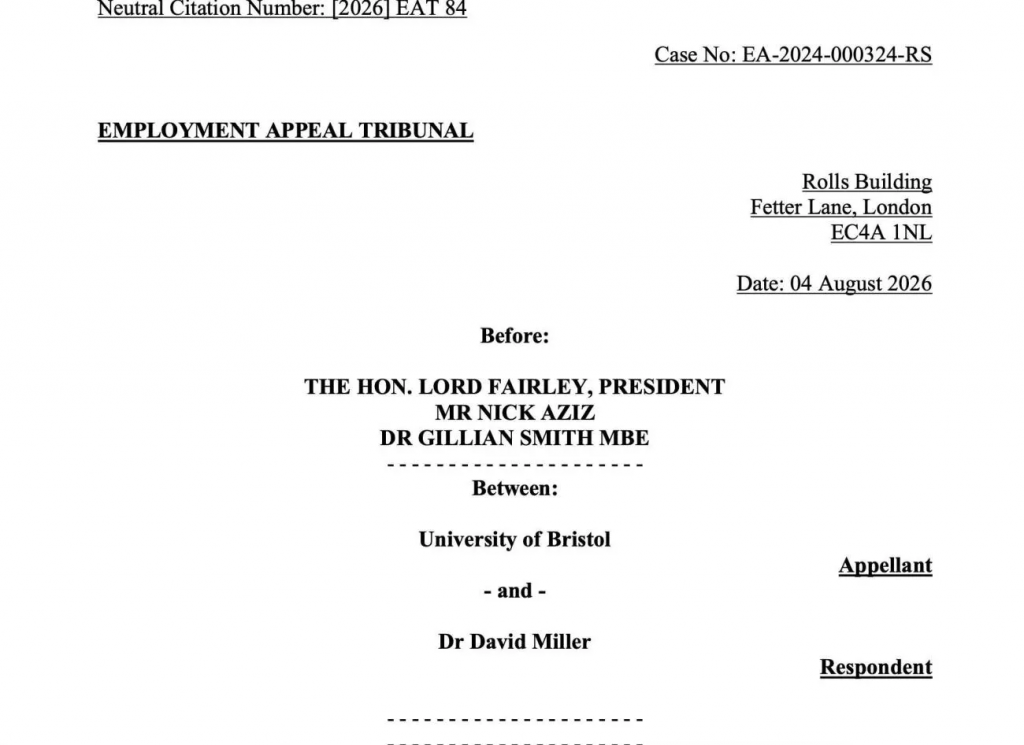
The delivery of the Employment Appeal Tribunal’s (EAT) judgment marks a historic milestone. This landmark ruling is a comprehensive validation of my long-standing academic work, an unmasking of institutional cowardice, and a binding legal precedent that secures the rights of all critics of Zionism and supporters of the Palestinian people across British higher education and in fact in all employment situations in the UK.
For nearly five years, the University of Bristol, operating under intense pressure from external Zionist lobby groups, sought to destroy my career, silence my sociological research, and establish a dangerous regime of censorship on campus. By dismissing me in October 2021 under the false banner of gross misconduct, the university administration threw its weight behind a targeted campaign of manufactured hysteria designed to conflate legitimate political critique with racial animus. In rejecting the university’s arguments, the court has delivered a forceful judgment that exposes the structural flaws, bad faith, and utter legal incompetence of the university’s strategy.
At the foundation of this case is the recognition of my anti-Zionist beliefs as a protected philosophical belief under Section 10 of the Equality Act 2010. Throughout my academic career as a sociology professor, my research has systematically examined concentrations of power, state propaganda, public relations, and lobbying. A central component of this research has been the Zionist movement and the imperial policies of the Zionist regime.
In its judgment, the Appeal Tribunal placed particular emphasis on the coherence and clarity of my beliefs, completely validating the intellectual framework that the university sought to anathematise. The judgment explicitly confirms that it is coherent to describe as “racist” an ideology that promotes — as Zionism does — the establishment of a state for only “one race of people (Group A) in a territory that contained a large number of people of a different race (comprised of Group B)” [Para 65(iv)]. It is a matter of clear historical and sociological fact that the realisation of Zionist ideology involved the “migration of members of Group A into the territory with the support of an imperial power to dislodge an indigenous population” [Para 65(iv)]. By affirming that this viewpoint is a protected philosophical belief worthy of respect in a democratic society, the Tribunal has stripped away the primary weapon used by the Zionist movement to silence dissent. Academics, students, and activists can no longer be lawfully targeted for summary dismissal, disciplinary exclusion, or suspension simply for identifying the structural racism inherent in the Zionist project.
Furthermore, this judgment provides an absolute moral and factual vindication against the character assassination I have faced. For years, Zionist lobby groups operating on and off British campuses have weaponised allegations of antisemitism to shield the Zionist regime from legitimate criticism. The appeal tribunal unequivocally “reiterates the finding that [Dr Miller] did not oppose or hold antipathy towards Jews or Judaism” [Para 135]. My criticism is, and has always been, directed at Zionism as an ideology and the violent, exclusionary practices of the state it produced. The Tribunal’s acceptance of this fact establishes a clear legal firewall between anti-Zionism and Judeophobia. It proves that the university’s internal disciplinary process was not motivated by a genuine desire to protect students from bigotry, but was rather an act of unlawful direct discrimination targeting a specific, inconvenient political perspective. The court recognised that my speech was entirely lawful, did not incite violence, and posed no threat whatsoever to anyone’s physical safety. This conclusion tears down the deceitful narrative that anti-Zionist academic speech creates an inherently hostile environment for students.
The sheer forcefulness of the Appeal Tribunal’s judgment is most evident in its systematic dismantling of the University of Bristol’s legal arguments, which were characterised by a combination of arrogance, bad faith, and operational failure. The university’s entire appeal was built upon a frantic attempt to re-litigate the facts established at the original tribunal and manipulate the record. This poorly executed strategy was evident from the very first day of the original employment tribunal hearings, which began inauspiciously, as it might have been seen some nine days after the launch of the Al-Aqsa Flood operation by the Palestinian Resistance. As recorded by the court, the university’s lead counsel, Christopher Milsom, made a binding concession on the first day of the hearing that the issue of my “true beliefs” was “unequivocal” [Para 136], stating explicitly: “If I can be absolutely clear, I am not seeking to go behind what the claimant says his true belief is” [Para 63]. Yet, throughout the appeal, the university repeatedly and dishonestly tried to reverse its position, claiming that the Tribunal had “impermissibly stripped away inconvenient parts of [the claimant’s] true beliefs” [Para 136]. The Appeal Tribunal flatly rejected this duplicitous tactic, noting that the “concession by the appellant’s Counsel on the first day of the hearing was clear and unequivocal, and [the] issue of ‘true belief’ was thereafter wholly absent from the evidence” [Para 136].
This pattern of structural and professional failure reached a point of public embarrassment during the appeal hearings before the EAT itself last November. In an extraordinary display of poor time management and tactical incompetence, the judgment notes that “the appellant’s counsel used up all of his agreed time allocation on his first speech, leaving himself no time for a reply speech” [Para 59]. This catastrophic failure meant that the university’s elaborate, 92-page written case collapsed under its own weight, leaving them entirely unable to respond to our oral arguments. It was a fitting metaphor for the university’s entire campaign against me: an overblown, expensive, and ultimately hollow exercise in administrative overreach that disintegrated when subjected to rigorous legal scrutiny.
The forcefulness of the EAT’s language leaves no room for ambiguity regarding the university’s desperation. The judgment addresses the university’s grounds of appeal which asserted that there were “no findings as to what operated on the mind of the individual members of the [appeal] panel” [Para 144], which had confirmed that I should be sacked. The Tribunal dismissed this claim using the direct and biting phrase that the university’s contention is “simply wrong” [Para 144]. The EAT pointed out that the lower tribunal had made extensive, detailed findings showing that “the appeal panel adopted the analysis of Professor Norman in her dismissal letter without any material alteration” [Para 144] and that her “reasons were endorsed by the appeal panel” [Para 144]. By rubber-stamping an act of direct discrimination, the university’s appeal panel and by extension its senior management ensured that their entire internal process was thoroughly infected with illegality.
The EAT was withering in its description of the overall Bristol case: “The appellant challenges all of the liability findings made against it … It has nine grounds of appeal. These are very lengthy because the majority of them contain multiple sub-grounds (and, in some cases, sub-sub-grounds) each of which alleges a separate error of law” [Para 6]. The EAT’s critique was equally severe when addressing the university’s sprawling challenge to the issue of proportionality. The judgment notes that Christopher Milsom advanced an absurd litany of criticisms comprising “seven ‘headline’ points and thirty separate sub-points” [Para 154] on proportionality alone. The Tribunal characterised this mountain of legal paperwork as “ultimately no more than expressions of disagreement with the conclusion reached by the Tribunal and an attempt to re-try the issue of proportionality” [Para 154].
The EAT admonished the university for failing to engage with established legal standards, noting that “at no stage, however, does the appellant engage with Shvidler by identifying a basis in law that would justify interference by an appellate court” [Para 154]. This is a severe indictment of a major public institution, demonstrating that the university spent many thousands of pounds of public money on an appeal that was nothing more than an expensive tantrum designed to re-litigate a lost factual dispute. It’s also worth emphasising that the university forced me into spending many thousands on legal support to defend myself. If it were not for thousands of supporters who generously contributed to my legal fees, we would not be here now.
The EAT further sharpened its language when addressing the university’s attempt to overturn the unfair dismissal finding. The Appeal Tribunal stated that the university’s ground of appeal was “simply an expression of disagreement with conclusions that were properly reached by the Tribunal” [Para 160]. It explicitly characterised the university’s case as “an invitation to this Tribunal, which we reject, to usurp the function of the first-instance Tribunal sitting as an industrial jury” [Para 160].
Similarly, the court exposed the procedural incompetence of the university’s legal team by confirming that it was “not competent to seek a pre-emptive ruling from this Tribunal on a matter that has been expressly reserved by the trial court and has still to be determined” [Para 171] at the future remedy hearing, where compensation to be paid to me will be determined. The university’s attempt to bypass standard legal procedures and extract a premature judgment from the EAT was flatly denied.
This victory is a total vindication of my position and for the anti-Zionist cause, and a crushing defeat for the University of Bristol. By exposing the university’s legal strategy as a chaotic mix of broken concessions, procedural incompetence, and illegitimate appeals, this judgment serves notice to all university administrations. As the court rightly observed, an academic institution “ought to be prepared to face and to weather criticism and reputational damage which flows from the exercise by its academics of their rights to speak and think freely and lawfully on areas within or connected to their research and expertise” [Para 47]. For too long, vice-chancellors and university boards/courts have chosen to capitulate to intimidation by genocidal Zionist groups rather than defend academic freedom. They have treated their students as vulnerable clients to be shielded from challenging realities, while victimising those who challenge power. And they have treated their professors as disposable corporate assets to be sacrificed at the first sign of bad public relations.
The legal precedent set by this case is now binding across the United Kingdom. It establishes that the articulation of anti-Zionist critique is fully protected under British employment law. It ensures that no academic can be summarily dismissed because their research happens to offend the political sensitivities of a genocidal apartheid state or its domestic advocates. This victory belongs to every student who has been intimidated for wearing a keffiyeh, every lecturer who has been threatened with disciplinary action for teaching the role of Zionism in promoting Islamophobia, and every citizen who refuses to be silenced by the systematic weaponisation of bad-faith smears.
The Zionists via the University of Bristol tried to make an example of me to deter others; instead, through their own arrogance and legal failure, the university has helped secure a binding legal shield that will protect the movement for Palestinian liberation and the dismantling of Zionism for generations to come.
I now look forward to returning to work as Professor of Political Sociology at the University of Bristol, to have my career reinstated, and be free to work in higher education without fear of intimidation or reprisal.
(Featured Image: Provided by David Miller)