

Examining an alt-media claim, and probing discrepancies in when and how elite virologists say they heard about a Wuhan outbreak
In May 2026, De Andere Krant (“The Other Newspaper”), an alternative-media outlet in the Netherlands, reported that virologist Marion Koopmans, a co-designer of the first WHO-posted real-time RT-PCR (1) protocols for Wuhan coronavirus 2019/2019-nCoV, (2) made an incorrect statement under oath and may have perjured herself before the Netherlands Parliamentary Committee of Inquiry into COVID-19. (3)
This analysis explains the Dutch journalist’s claim, evidence, and reasoning, and assesses whether the perjury allegation is warranted. It also considers what Koopmans, her colleague Ron Fouchier, and several other virologists said they heard or saw; when and how they heard or saw it; and what any committee or media outlet should be asking about early episodes related to the COVID-19 event. As will become clear, the accounts of who heard what, and when, rest largely on later recollections rather than contemporaneous documentation, and where documents do exist, they tend to complicate the stories rather than confirm them.
The assessment that follows is, in part, dependent on interpretations of machine translations of broadcasts, transcripts, articles, and law, and is open to correction where language may have led to incomplete or faulty conclusions. (4)
The Possible-Perjury Allegation
In “Pleegde Marion Koopmans meineed?” (“Did Marion Koopmans Commit Perjury?”), published on 29 May 2026, De Andere Krant journalist Toine de Graaf wrote: (5)
There are strong indications that virologist Prof. Marion Koopmans lied under oath during the first public interrogation of the parliamentary committee of inquiry Corona. Koopmans stated that she received the first signal of the virus outbreak in Wuhan on New Year’s Eve 2019, after which she immediately contacted the World Health Organization (WHO). Several international virologists with whom Koopmans was in direct contact, including her direct Erasmus MC colleague Prof. Ron Fouchier, however, have previously stated that they heard of the outbreak in early or mid-December 2019. It seems that Koopmans is trying to disguise the fact that she did not sound the alarm about the approaching pandemic for weeks.
From there, de Graaf focuses on an exchange between Koopmans and committee vice-chair Songül Mutluer, when Mutluer asked Koopmans about the beginning of the alleged outbreak in China:
At that time, you are a leading virologist with a broad international network. And you get those first signals about the existence of the virus. When did you first hear about the virus discovered in Wuhan?
Koopmans replied, “The first signal that something was going on was New Year’s Eve 2019.”
Her source, she said, was “a message via social media in which a financial newspaper reported on a call from a sort of public health service in the city of Wuhan” that reportedly had seen many people with pneumonia who had visited a market. When Mutluer asked Koopmans pointedly about when she contacted colleagues at the WHO about the possible outbreak, Koopmans cited the same day: 31 December 2019.
According to de Graaf, Koopmans’s account gave committee members and members of the public the impression that she acted promptly after receiving the first signal of a potentially serious outbreak. De Graaf cites statements by Koopmans’s Erasmus MC colleague Ron Fouchier and by Columbia University’s Ian Lipkin, drawn from two authors who favor the “lab leak” hypothesis, Jan Bonte (De Wuhan Trilogie, 2024) and Jim Haslam (Covid-19: Mystery Solved, 2024), to argue that Koopmans must have heard about the reported outbreak earlier than she claimed.
Dutch Perjury Law and the Committee’s Response
Under Article 13(1) of the Wet op de parlementaire enquête 2008, when an inquiry committee requires witnesses to testify under oath, the witness swears or affirms that he or she will tell “the whole truth and nothing but the truth.” (6)
In a 2023 perjury case arising from a parliamentary inquiry, the District Court of Midden-Nederland convicted a foundation chairman for confirming under oath that his organization did not have certain documents, which he must have known it had. (7) The court held that the prosecution must establish that the witness was aware the statement was false, and it attached “great weight” to the context of the examination and the manner in which the questions were phrased. On other answers, the court acquitted him, finding that answering in general terms without providing a concrete answer did not necessarily amount to a false statement. Nor could the witness be expected to work out what the committee really meant; he was entitled to rely on the questions as worded.
Applied to de Graaf’s allegation, the case suggests that a specific false answer to a specific question can be perjury, while a general or reframed answer to a loosely worded question is unlikely to be.
De Graaf’s 7 June follow-up, “Coronacommissie maakt (nog) geen werk van liegende getuigen” (“Corona Committee Is [Not Yet] Taking Action Against Lying Witnesses”), reported that De Andere Krant had asked the committee how it handles witnesses who may have lied. (8)
A spokesperson said the committee’s assessment of the testimony would appear in its final report, expected in the first quarter of 2027, and that the committee would “act according to circumstances if necessary.”
What Koopmans Actually Said
A close reading of the related sections in Koopmans’s testimony does not appear to strongly support a perjury allegation, although it leaves room for the possibility. (9)
Mutluer did not ask Koopmans, “When did you first hear any formal or informal report of unexplained pneumonia in Wuhan?” She asked, “When did you first hear about the virus that had been discovered in Wuhan?”
An English rendering (10) of Koopmans’s initial response follows:
The first signal that something was going on came on New Year’s Eve 2019. I just saw the opening video. (11) That of course begins with the moment of the first case in the Netherlands [27 February 2020], but almost two months before that, quite a lot was already going on.
On New Year’s Eve 2019 there was a message on social media in which a financial newspaper reported on an appeal from a kind of municipal health service in the city of Wuhan. It had seen a strikingly large number of people with pneumonia, and those people had been to a market. That is one of the many signals that are shared internationally every week and that the WHO and, for example, the RIVM [Rijksinstituut voor Volksgezondheid en Milieu, the National Institute for Public Health and the Environment] look at, in the sense of: does something need to be done about this?
It was such that I myself also contacted colleagues at the WHO; that is the World Health Organization, I say just to clarify the abbreviation. Those colleagues said: we are working on it; we don’t know yet. But three days later something started doing the rounds on social media again, that there might be a laboratory result with the term SARS on it. That was the first trigger for me to think: uh-oh, what is going on there? SARS is an abbreviation for another coronavirus, of which we have seen earlier outbreaks (12). Those were stopped. They also came from animals, but they caused very severe pneumonia. That picture was really the start of a great many international actions, to look at: “What if this is indeed a new coronavirus in people in Wuhan? What should we start doing now so that we can, for example, test for it if a traveler from Wuhan were to arrive?” That was really the start for me.
Koopmans did not begin her answer by adopting Mutluer’s wording or by saying, “I first heard about a virus discovered in Wuhan when…” Instead, she reframed the question and described, in broader terms, “the first signal that something was going on.” This is not necessarily equivalent to the first time she heard any rumor or rumbling involving illness in Wuhan.
Her closing phrase – “that was really the start for me” – appears to refer to the beginning of international actions and her own work related to test development, rather than to the beginning of her awareness that something might be happening in Wuhan.
The mention of a (supposed) laboratory result bearing the term SARS being her “first trigger” to ask, “what’s going on there?” could be understood as a partial or eventual answer to Mutluer’s original question.
Koopmans could say that she didn’t interpret Mutluer’s wording (“the virus discovered in Wuhan”) as encompassing every earlier rumor or informal report of unexplained pneumonia. She could also claim that her answer supplied the background she considered relevant to the “discovery” of a virus. Or she could point to having said later in her testimony that various “global alert” systems send “signals” of potential disease events each year, a very small number of which require further examination:
There are all kinds of worldwide alert systems. They are monitored. The WHO, but also the European CDC, the RIVM, we, look at them and see whether there is something here that needs extra attention. In Europe alone, something like 20,000 such signals are looked at every year. About 50 times it is something you really have to act on. The first step is really to look: what is going on here and who can provide more information about it? Then you depend on the information that comes from the place where it is happening.
From this perspective, an earlier rumor about Wuhan would have been one of thousands of unconfirmed signals, not “the virus discovered in Wuhan,” and Koopmans’s answer fits the kind of general, reframed response the Midden-Nederland court declined to treat as perjury.
De Graaf’s position is that Koopmans possessed information for weeks, should have acted on it prior to 31 December but didn’t, and instead attempted to conceal her failure to “sound the alarm about the approaching pandemic.”
To validate that assertion, the committee would need to determine what information Koopmans received, when she received it, what she understood it to mean at the time, and whether it was information that reasonably required or compelled actions she should have taken and chose not to.
That’s a high bar: one that neither the questions Mutluer posed, nor the responses Koopmans gave, seem able to meet.
The Fouchier-Koopmans Discrepancy
De Graaf is correct that statements made by Ron Fouchier in spring 2020 warrant further scrutiny and create a discrepancy with what Koopmans testified. Examining Fouchier’s early stories, I also found his later explanation unconvincing. (13)
In VPRO Tegenlicht’s Virus van morgen (“Virus of Tomorrow”) broadcast on 22 March 2020, Fouchier said he first heard about an outbreak involving an unknown disease in Wuhan “just after Sinterklaas,” which could mean 6 December 2019 or shortly thereafter. (14)
The version posted to YouTube (15) captions the exchange as follows:
Narrator: Fouchier and Koopmans were the first to hear about the outbreak in China. They heard alarm bells while most people thought it was a local problem.
Interviewer: Where were you when you first heard about that crisis in China?
Ron Fouchier: We hear about these kinds of things very early. This was, I think, just after Sinterklaas, in early December. That was when we heard about outbreaks of an unknown disease in Wuhan.
Marion Koopmans: The beginning of this – like the entire course of events – was very unusual. It simply came through social media. And through a newspaper. So those first weeks of commotion were exactly the same as those we experienced in 2003 with the SARS outbreak.
The narrator’s characterization isn’t evidence of what either virologist heard, or when, but Fouchier’s own answer places his awareness in early December. He also says “we,” not “I”. Given the professional context of the interview, it seems unlikely that he is referring to his own family members.
Fouchier gave another account to Algemeen Dagblad in an interview published on 5 April 2020 (16):
Question: When did you realize that something serious was going on in China?
Fouchier: I was on vacation when, in December, there was commotion in the infectious disease world. There were rumors that people had fallen ill, and that it had something to do with an animal market. Over the course of December, it became clear that it was a coronavirus that was reportedly transmissible through the respiratory tract. That’s when all the alarm bells start ringing for a virologist.
In this retelling, Fouchier associated hearing rumors with being “on vacation” rather than specifically with Sinterklaas. “In the course of December” points to information that had been circulating for weeks, rather than only in the final days of the month. That “it became clear that it was a coronavirus” during the timeframe is also a noteworthy statement because no coronavirus had been publicly identified until early January.
In a revision de Graaf doesn’t mention, Ian Birrell later reported (Mail on Sunday, 5 September 2021) (17) that Fouchier had told the documentary he discussed the outbreak with Koopmans in the first week of December, a link Fouchier does not make on camera. When Birrell contacted him, Fouchier, by Birrell’s account, said he had been muddled over the dates and that the discussions were in late December. The only words Birrell quotes from him are “I am sorry about this confusion.”
Fouchier’s “correction” via Birrell is unpersuasive if only because his initial recollections were then fairly recent and associated with a specific holiday or being on a trip. It’s more likely that Fouchier amended his memories to avoid uncomfortable questions as media, politicians, and the public were interrogating origin stories.
Like Toine de Graaf, I considered it “inconceivable” that Fouchier had heard about an outbreak while Koopmans, his department head at Erasmus MC, had not.
Earlier this year, I submitted a freedom-of-information request to Erasmus MC for emails between Fouchier and Koopmans from November and December 2019. The request was denied under Dutch law. (18) The two virologists could have communicated in other ways, of course. De Graaf cites Jim Haslam’s suggestion that word spread among virologists at the Nipah Virus International Conference in Singapore on 9–10 December 2019. Neither Koopmans nor Fouchier is named in the published meeting report (19) or among attendees at a related meeting on 11 December. (20) Conversations at a professional gathering wouldn’t necessarily be documented, and news can travel quickly within and between networks. Given the timing, a conference is a reasonable guess as a secondhand source for Fouchier’s early-December story, but no record seems to support it.
Returning to the potential-perjury issue: Fouchier’s memories do create a factual discrepancy with his colleague. They do not establish what Koopmans knew, precisely when she knew it, or that she knowingly lied. Her answer could be construed as evasive, incomplete, or misleading. This is different from consciously making a false statement under oath.
What Did Koopmans See?
Koopmans’s testimony about where and how she encountered the “first signal” is worth examining irrespective of de Graaf’s perjury allegation, because it relates to a statement she and co-authors made in the published paper version of the protocol in Eurosurveillance on 23 January, “Detection of 2019 novel coronavirus (2019-nCoV) by real-time RT-PCR”. (21) The beginning of the design process is described this way [emphasis added]:
Before public release of virus sequences from cases of 2019-nCoV, we relied on social media reports announcing detection of a SARS-like virus. We thus assumed that a SARS-related CoV is involved in the outbreak. (22)
Koopmans’s narrative to the Netherlands committee includes details that are absent from this two-sentence description and from the March 2020 program with Ron Fouchier. She was more specific in her testimony about her source for the initial report, the order in which she encountered information, and the significance she attached to a purported laboratory result. Because she related these details under oath and on an official record, they warrant scrutiny, though what she describes is her own recollection and does not necessarily speak for her co-authors.
Koopmans testified that it was a New Year’s Eve message circulating through social media, originating with a financial newspaper and concerning a Chinese local health authority’s report of a pneumonia outbreak, that prompted her to contact colleagues at the WHO.
The newspaper was likely Yicai (First Financial), which published an article on 31 December 2019 (23), or Sina Finance (24), which republished it. The route by which the report reached Koopmans is less clear. Possible channels include ProMED-mail (25), EcoHealth Alliance president Peter Daszak’s amplification of reports on Twitter (26), or posts from anonymous users on one or more platforms, such as the one reproduced below (27) and which is Translated here) (28).
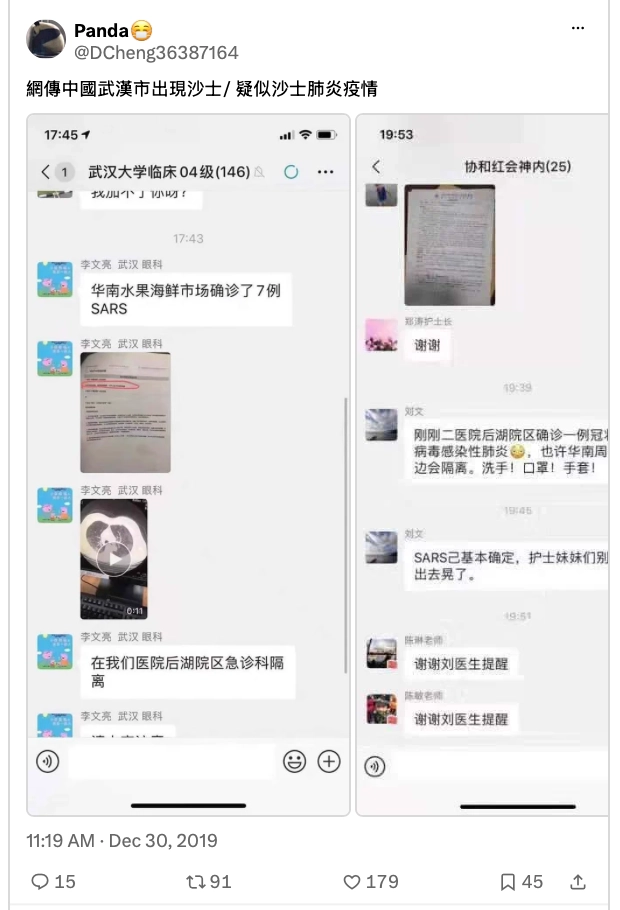
Koopmans also testified to the Dutch committee that three days after New Year’s Eve (around 3 January 2020) she “again” saw “something” circulating on social media suggesting that “there might be a laboratory result with the term SARS on it.” She described this as her “first trigger” to ask what was happening and, by implication, to take the reports more seriously.
An image of such a report appears to have debuted on 30 December 2019, (29) including in the tweet shown above, and circulated through WeChat and other social-media channels after allegedly being shared by doctors, including Ai Fen and Li Wenliang. (30) The lab report itself doesn’t need to have been authentic, or indicative of a pneumonia outbreak caused by novel coronavirus, to have influenced Koopmans’s perception at the time.
A separate possibility concerns sequences purportedly obtained on 3 January 2020. Scientists at China’s National Institute for Viral Disease Control and Prevention later reported, in China CDC Weekly (20 January 2020) (31), that they had identified the first complete genome of a novel betacoronavirus from bronchoalveolar lavage fluid taken from a Wuhan patient, using a combination of sequencing techniques. Koopmans may have encountered an informal or second-hand report concerning those sequences, perhaps conflated with the earlier laboratory screenshot. But that account is retrospective: the paper was submitted on 19 January and doesn’t establish that any such “result” was circulating online in early January.
Other possibilities exist. The point is that nothing in the record establishes precisely what Koopmans saw on or around 3 January, nor do her own descriptions (“something started doing the rounds,” “there might be a laboratory result”) identify a source. Her references are consistent with the lab-report screenshot circulating since 30 December, but she was not asked to clarify.
What she said immediately following is on the record. On 4 January, Helen Branswell’s STAT article on the “mystery pneumonia outbreak” in Wuhan quoted Koopmans: “I think we need to give them [Chinese authorities] a couple of days, but I want to hear something from a credible source on the investigations that are ongoing.” (32) She also said she had questions she wanted answered “very soon.” Whatever Koopmans had encountered by then, she was saying publicly that she was waiting for confirmation from a source she trusted.
Lipkin’s Shifting Accounts
Something else de Graaf did not mention, though it relates directly to the claim he borrowed from Jan Bonte, is how Ian Lipkin’s own account changed over time. Lipkin, technical adviser on Contagion (2011) (33) and the model for one of its characters, has repeatedly dated his first word of the outbreak to mid-December 2019. Who told him, what he was told, and what he did next vary from one telling to the next.
His earliest account came on This Week in Virology with Vincent Racaniello (28 March 2020). (34) Lipkin said he first heard of the outbreak “on the 15th of December from Jiahai Lu,” a Sun Yat-sen University professor with whom he ran a joint program. He said he then “wrote to… other colleagues nationally in China to ask about this outbreak in Wuhan.” On “the 31st,” he said, he “heard that they’d identified this coronavirus” and “tried to push for a release of sequences,” which “really didn’t come out until about a week and a half later.”
Nearly a year later, in the FRONTLINE documentary China’s Covid Secrets (February 2021), he recalled being “in a restaurant waiting to ring in the new year” when George Gao, director of China CDC, called him on WeChat. Gao had “identified the virus, it was a new coronavirus and that it was not highly transmissible.” (35) That “didn’t really resonate,” Lipkin said, “because I’d heard about many, many people who’d been infected.” Gao, he said, “should have released some sequences” but wasn’t “duplicitous” in not doing so, “just wrong.”
Interviewed by staff of the House Select Subcommittee on the Coronavirus Pandemic in April 2023, Lipkin gave a thinner and different account. (36) The mid-December tip no longer came from Lu. When staff put it to him, he agreed it had come from Hana Lin, a technician in his Columbia lab, in a brief, undocumented phone call while he was in Egypt. Asked whether she had told him about a possible new virus in Wuhan, he said no – only “some sort of respiratory outbreak,” possibly not even viral. Elsewhere in the same interview, he spoke of “something that was circulating in Wuhan in mid-December” and referred to “the December 15th call,” yet when asked to confirm the date he said, “Middle of December. I’m not precisely clear.” It was “no four-alarm fire,” he said, and he “didn’t hear anything until the end of the month.” He didn’t mention writing to his national-level contacts in China. Gao’s message, he now said, was a voicemail left after a missed call, not the WeChat call he had described to FRONTLINE. Gao, he said, had asked him to keep it confidential, and Lipkin asked the committee interviewers to do the same, despite having described the essence of the message on television two years earlier.
At minimum, Lipkin’s variations leave unresolved who told him what in December, and how he came to hear of “many, many people” infected before New Year’s. All three accounts described above have him learning on New Year’s Eve that a new coronavirus had been identified, within a day of Wuhan officials’ public report of only pneumonia cases, and days before the “trigger” Koopmans described. In two of the accounts, the source is the head of China CDC.
Early Words for Berlin
De Graaf anchors his case for early knowledge in Fouchier in Rotterdam and Lipkin in New York. He never mentions the Berlin team led by Victor Corman and Christian Drosten at Charité’s Institute of Virology, the chief architects of the test Koopmans helped design, even though their awareness arguably bears most directly on hers.
Public statements by or about Victor Corman and Christian Drosten place the start of their work before her 3 January “trigger.” But they disagree about when, and how, word first reached Berlin.
The earliest accounts point to China. On 20 January, the Berliner Zeitung reported that the Charité virologists began asking “Can we do something?” shortly before New Year’s Eve, once virologists in Wuhan had themselves raised the suspicion of a SARS-like virus. “We know the colleagues,” Drosten said. (37) Around 23 January, he told Deutschlandfunk that “the first informal information arrived here” between Christmas and New Year’s, and that his team set to work immediately. (38) The journalist, Volkert Wildermuth, added that Drosten had learned of the new virus early “through contacts with researchers in China.” (39)
The Eurosurveillance paper published that week tells a different story. Before any sequences were public, it says, the authors “relied on social media reports announcing detection of a SARS-like virus.” It doesn’t mention the Wuhan virologists Drosten said he knew, or any other source in China for that early information. The paper’s acknowledgements do name researchers at China CDC, the Wuhan Institute of Virology, and the Institute of Pathogen Biology in Beijing, but only as submitters of genome sequences shared through GISAID from 12 January.
Later media coverage follows the published paper rather than the interviews, and the date moves. In March 2020, Berliner Zeitung reported that a Charité staff member had spotted reports of a new illness on Twitter and that the team was alerted on 30 December. (40) A Science profile in April 2020 credited Victor Corman with seeing “the first rumors about a coronavirus in China online,” without giving a date. (41) By June 2020, The Independent had Drosten hearing about the outbreak from a lab member who saw it on Twitter “the next day,” in context meaning 1 January, the day after Wuhan’s first public statement. None of these press accounts names a source for its version. (42)
Corman’s own accounts are more detailed, and they place Berlin’s first word on the same day as Koopmans’s. Interviewed in September 2020 for a RiffReporter feature (43) published the following year, he described being in the lab on New Year’s Eve, running a test on a suspected MERS patient, when a colleague emailed him a Reuters report: Wuhan health authorities were investigating 27 cases of viral pneumonia, and rumors on social media suggested SARS had returned. (44) He then checked Virological.org and ProMED-mail. In a 2022 interview published by Charité, Corman again dated it to “the last day of 2019” when he “got a message from a colleague” about “rumors on social media.” (45) In the first days of January, he said, he updated a dataset of SARS-related bat viruses and worked out how he would design a test.
On 11 January 2020, replying to a since-deleted tweet from the virologist Ian Mackay, Corman wrote that he had “started ordering oligos already in 2019.” (46)
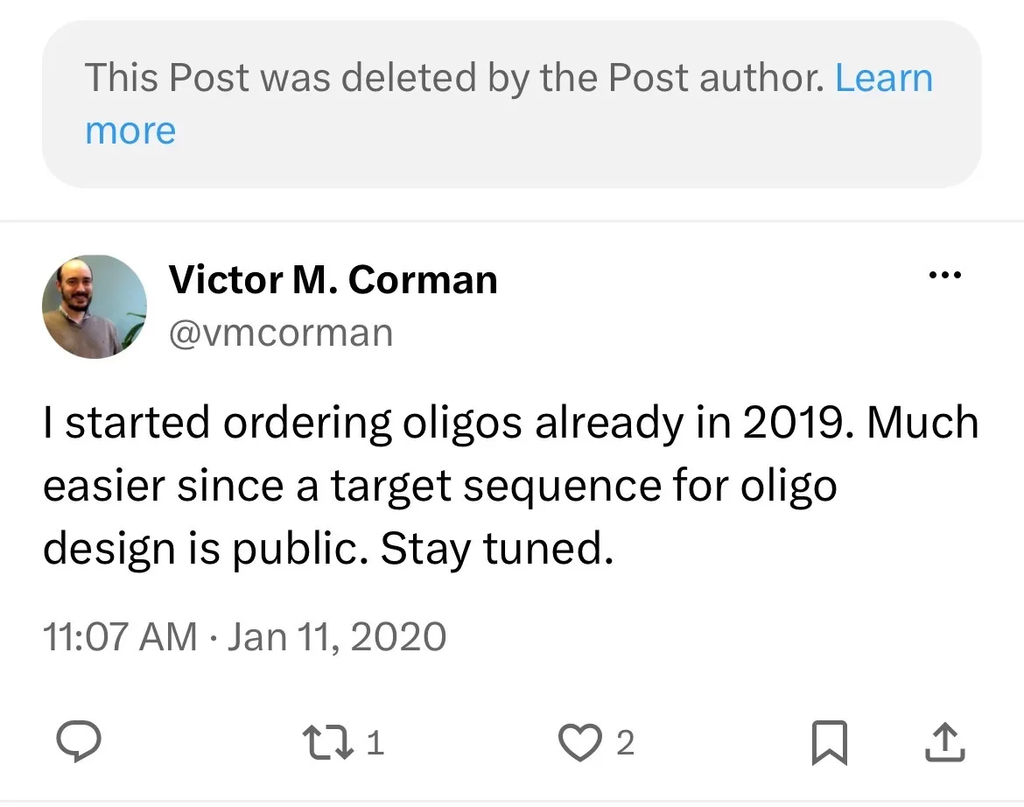
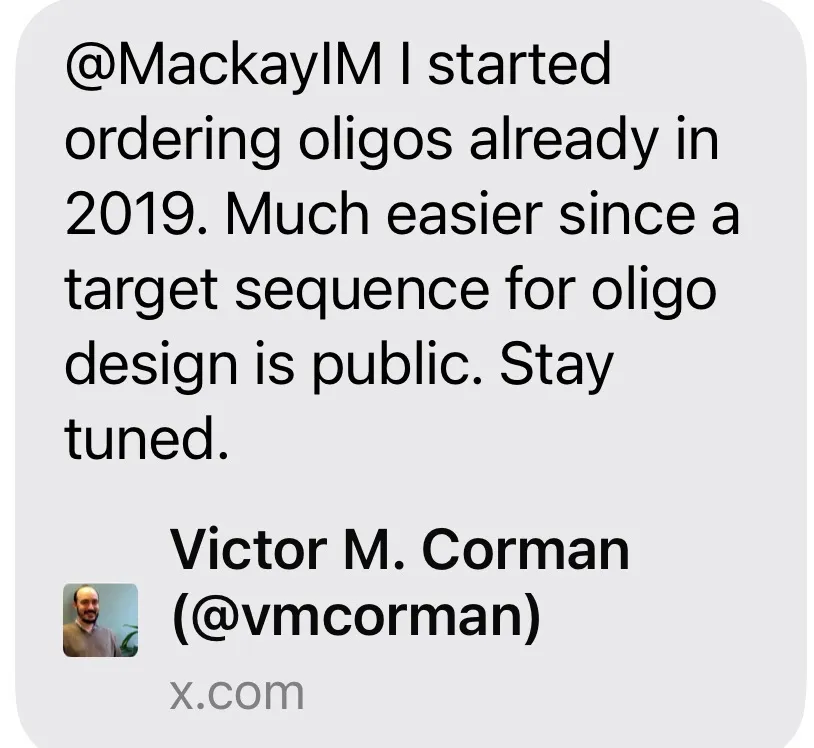
Whether those orders were for a rumored coronavirus per se, and whether “2019” refers to anything earlier than New Year’s Eve, is unclear. But the ordering had begun before the “first days of January” in which he later recalled starting the design.
Taken together, the Berlin accounts I reviewed agree only that word came through unofficial channels and the work began before Koopmans’s 3 January “trigger.” Speaking in January 2020, Drosten placed it between Christmas and New Year’s and, at least by his interviewer’s account, credited contacts in China. Corman, who led the design, has since placed it on New Year’s Eve, from a news report and social-media rumors passed on by a colleague: the same day, and the same kind of second-hand report, that Koopmans described under oath. His own tweet at the time leaves open an earlier start.
What Should Be Asked
Marion Koopmans testified that “around 10 January it was said for the first time that it was indeed a new coronavirus” [emphasis added]. (47) The Eurosurveillance paper she co-authored dates that to an announcement “by Chinese authorities on 7 January,” without a citation, and notes that virus isolates and patient samples were not yet available. Who said “it”, and on what evidence, she was not asked.
What not only the Netherlands committee but also the public should be asking, then, goes beyond whether Marion Koopmans lied under oath (i.e., de Graaf’s perjury allegation).
- When did virologists at Erasmus MC and other institutions first hear Wuhan rumors, on or before 31 December 2019, through what channels (including conferences), and can it be corroborated with documentation?
- Is what those virologists say they heard, saw, or were told evidence of an outbreak? Is it evidence of an attempted cover-up of an outbreak on the part of one or more individuals, agencies, or governing bodies? Could it be (or also be) evidence of something else entirely?
- What did Koopmans and her testing protocol co-authors learn, and from whom, that satisfied them that a novel SARS-related coronavirus was the cause of the Wuhan cases, before and after the sequences were released?
If Dutch legislators can obtain communications unavailable to an ordinary or foreign records requester, question Koopmans again, or interview Fouchier and other prominent virologists in the country who were involved in test development and SARS-CoV-2 naming and classification activities about what they heard in December 2019, they should do so.
Alternative-Alternative Views
Toine de Graaf invited readers and the Netherlands Corona Committee to take a more critical view of Marion Koopmans and the other virologists who helped advance claims about a mysterious pneumonia outbreak in Wuhan. He is right to ask what Koopmans knew and when, and right to suggest that Mutluer lacked the “dossierkennis,” or command of the subject, to question Koopmans robustly on the matter.
De Graaf believes an outbreak was occurring, seems to hold a lab-origin view of SARS-CoV-2 himself, and therefore asks, “Why did top virologists keep this information [of an outbreak in Wuhan] to themselves for weeks?” But his theory that Koopmans knew an approaching pandemic was underway and failed to sound the alarm soon enough is only one way of reading the discrepancy with her colleague Ron Fouchier’s retellings.
Records or testimony showing that virologists at Erasmus MC or elsewhere received or overheard early reports would not prove, or necessarily be evidence, that a laboratory accident or “release” occurred, nor that a genuine cover-up of a lab incident followed.
Such records could instead help show how rumors started, or were introduced, and then circulated within a small international circle before public-facing episodes were broadcast and the WHO and member nations took actions. There are, after all, relatively few elite scientists who can be called upon to examine a purported viral sequence or develop a test for detecting it. As it stands, the record of this period rests heavily on later, and in some cases revised, conflicting, or incomplete, retellings by that select group rather than on contemporaneous documentation or corroboration.
Between Erasmus, Charité, and Columbia, at least, we have a set of recollections pointing to a very small, interlinked group of elite virologists, some of whom say they were tipped off to Wuhan weeks before the public had any inkling, while others say they heard only at some point between Christmas and New Year’s Day. Marion Koopmans testified that such early word is normal in the infectious-disease world. That may be true, but various on-the-record accounts don’t line up with one another, aren’t internally consistent, rest on reconstructed memories, and raise more questions than they answer.
This leaves room for an “alternative-alternative” view that doesn’t require that any kind of contagious-illness event was taking place: virologists were intentionally leveraged and effectively tricked into believing an epidemiological threat had emerged or escaped.
An exclusive cadre whose expertise, authority, and reputations carry enormous weight would be valuable to anyone seeking to steer an early narrative. Using a few well-primed scientists, without their full knowledge, to help carry out a large-scale psychological operation is well within the capabilities of intelligence agencies. None of the scientists involved would need to be a fully “knowing” participant for such an endeavor to succeed.
Official mortality data offer little evidence that a spreading deadly pathogen (48), or anything else, was killing “extra” people before mass testing and disaster decrees were deployed alongside draconian policies – including in places reporting the most dramatic death spikes. (49) Given this, and the outsized spotlight on theatrical militarized propaganda spectacles in Iran, Bergamo, Madrid, New York City, and elsewhere, other explanations for the rumors circulating among top virologists in late 2019 should be taken seriously and investigated further.
The Bigger Picture
Those who hold a no-pandemic view (as I do) may note that Toine de Graaf’s articles challenge Marion Koopmans while protecting the foundational claim that a novel, fast-and-sudden-spreading threat existed and an alarm should have been sounded – and should have been sounded earlier than it was – whether by virologists, the WHO, or Chinese officials.
Alternative or independent-media journalists who accept this claim without examining the constituent parts of what amounts to a state-sponsored narrative do less to expose root falsehoods – and less to protect future generations from repeat performances – than they may believe. (50) The solution is to treat sanctioned or elevated stories as unproven until demonstrated, and proceed accordingly, rather than assume anything we’ve been told is true or substantiated.
A COVID inquiry that probes witnesses under the presumption a pandemic occurred as a biological phenomenon, or that primarily seeks to affirm its own or others’ actions as justifiable under emergency circumstances, should not be regarded as an authentic, truth-seeking exercise.
Likewise, any inquiry that treats every decision taken between January 2020 and the WHO’s pandemic declaration as justified by extraordinary circumstances can only ever be performative. The same is true of any inquiries that concentrate solely on how “the pandemic” was “managed.” Such orientations inevitably reinforce the testing, surveillance, and vaccine-development-and-deployment programs at the center of pandemic preparedness that elite virologists such as Marion Koopmans openly promote.
Two fundamental questions should frame and guide national or international examinations of the events of late 2019 and early 2020, and of associated media coverage:
- Was the WHO pandemic declaration warranted?
- Should authorities of any country have endorsed and acted on it? Why or why not?
These invite more evidence, more kinds of evidence, and more honest examinations of what was known and unknown, without preventing an assessment of the actions that authorities took in “response”. Unless a committee is willing to frame and view its charge through a critical lens, any information gathered and conclusions reached are likely to affirm pandemics as biological phenomena and fuel preparations for “the next one.”
An oath obliges a witness to answer truthfully the questions he or she is asked, not the ones a committee never thought or dared to pose.
Whether Marion Koopmans told “the whole truth” may matter less, in the end, than whether anyone in the room – or in the world – was prepared to request it, hear it delivered, or handle the implications.
- Reverse transcription polymerase chain reaction. A test for detection of genetic sequences attributed to the new virus in respiratory samples.
- Corman, Victor, et al. “Diagnostic Detection of Wuhan Coronavirus 2019 by Real-Time RT-PCR.” Version 1. Geneva: World Health Organization, January 13, 2020. https://www.who.int/docs/default-source/coronaviruse/wuhan-virus-assay-v1991527e5122341d99287a1b17c111902.pdf. Corman, Victor, et al. “Diagnostic Detection of 2019-nCoV by Real-Time RT-PCR.” Version 2. Geneva: World Health Organization, January 17, 2020. https://www.who.int/docs/default-source/coronaviruse/protocol-v2-1.pdf. Charité/Berlin protocol, versions published on the WHO site 13 January 2020 and 17 January 2020.
- House of Representatives of the Netherlands. “Parliamentary Inquiry Committee on Corona.” https://www.houseofrepresentatives.nl/members_of_parliament/committees/pec.
- Translations of Dutch- and German-language articles via Google Chrome’s built-in translation, unless otherwise noted.
- de Graaf, Toine. “Pleegde Marion Koopmans meineed?” De Andere Krant, May 29, 2026. https://deanderekrant.nl/pleegde-marion-koopmans-vanochtend-meineed/. English translation of official uncorrected verslag (marked definitief) rendered via Claude (Opus 5.5.)
- Wet op de parlementaire enquête 2008 (version of June 2026). The Hague: Tweede Kamer der Staten-Generaal. https://www.tweedekamer.nl/sites/default/files/2026-07/Wet op de parlementaire enquête 2008 (juni 2026).pdf.
- Rechtbank Midden-Nederland. ECLI:NL:RBMNE:2023:6970. December 22, 2023. https://uitspraken.rechtspraak.nl/details?id=ECLI:NL:RBMNE:2023:6970.
- de Graaf, Toine. “Coronacommissie maakt (nog) geen werk van liegende getuigen.” De Andere Krant, June 7, 2026. https://deanderekrant.nl/coronacommissie-maakt-nog-geen-werk-van-liegende-getuigen/.
- Tweede Kamer der Staten-Generaal, Parlementaire enquêtecommissie Corona. “Verslag van een openbaar verhoor [mevrouw Koopmans].” Uncorrected stenographic record, May 29, 2026. https://www.tweedekamer.nl/sites/default/files/2026-06/20260529 Koopmans OPENBAAR VERHOOR verslag definitief.pdf.
- English translation of official uncorrected verslag (marked definitief) rendered via Claude (Opus 5.5.)
- Tweede Kamer der Staten-Generaal, Parlementaire enquêtecommissie Corona. “Begin pandemie,” Opening video, May 29, 2026. MP4. https://www.tweedekamer.nl/sites/default/files/PC3864_01_Begin Pandemie_Video externe website_Zonder SUB.mp4.
- SARS stands for severe acute respiratory syndrome. The “syndrome” is an alleged disease condition, while a “coronavirus” or “SARS-related coronavirus” is the alleged causative agent.
- Hockett, Jessica. “Post-Publication Appendices to ‘Did the Corman-Drosten Protocol Rely on Social Media Reports to Seek, Then Find, SARS-CoV-2?’” Wood House76. February 20, 2025. https://woodhouse76.com/2025/02/20/post-publication-appendices-to-did-the-corman-drosten-protocol-rely-on-social-media-reports-to-seek-then-find-sars-cov-2/.
- VPRO Tegenlicht. “Virus van morgen.” Broadcast March 22, 2020. https://tegenlicht.vpro.nl/artikelen/virus-van-morgen.
- VPRO Tegenlicht. “Virus van morgen.” YouTube video, uploaded March 27, 2020. https://www.youtube.com/watch?v=5DeUBLeMnjY.
- Van Mersbergen, C**.** “Viroloog: ‘Nederland is vol met gastheren die een virus over kunnen dragen.’” Interview with Ron Fouchier. Algemeen Dagblad, April 5, 2020. Archived at https://archive.ph/sshMA.
- Birrell, Ian. “Leading US Scientist: I Was Told About the Wuhan Outbreak Two Weeks before Beijing Warned the World.” Mail on Sunday, September 5, 2021. Republished at https://ianbirrell.com/leading-us-scientist-i-was-told-about-the-wuhan-outbreak-two-weeks-before-beijing-warned-the-world/.
- Erasmus MC. Decision on February 26, 2026 records request submitted by Jessica Hockett (“Besluit in primo”). April 2, 2026**.** https://woodhouse76.com/wp-content/uploads/2025/02/260402-Besluit-in-primo-Ms-Hockett.pdf.
- CEPI, Duke-NUS, WHO, and NIAID. “2019 Nipah Virus International Conference: Meeting Report” Singapore. December 9–10, 2019. Archived July 12, 2020. https://web.archive.org/web/20200712113901/https://cepi.net/wp-content/uploads/2020/06/2019-CEPI-Duke-WHO-NIAID-Nipah-Conference_FINAL.pdf.
- CEPI. “JCG Nipah Meeting Summary,” Meeting of December 11, 2019. https://static.cepi.net/downloads/2023-12/JCG-Nipah-Meeting-Summary.pdf.
- Corman, Victor M., Olfert Landt, Marco Kaiser, Richard Molenkamp, Adam Meijer, Daniel K. W. Chu, Tobias Bleicker, et al. “Detection of 2019 Novel Coronavirus (2019-nCoV) by Real-Time RT-PCR.” Eurosurveillance 25, no. 3 (2020): 2000045. https://doi.org/10.2807/1560-7917.ES.2020.25.3.2000045. Also available at https://pmc.ncbi.nlm.nih.gov/articles/PMC6988269/.
- The 20 January 2020, draft of the paper (submitted January 21) is included in correspondence I obtained from UKHSA by records request. [UK Health Security Agency. Correspondence released to Jessica Hockett under records request, including the January 20, 2020 draft of Corman et al. Requested August 27, 2025. Released November 11, 2025**.** https://woodhouse76.com/wp-content/uploads/2025/11/binder1_redacted-x-1.pdf.] It contains only the first of these sentences: “Before public release of virus sequences from cases of 2019-nCoV, we relied on social media reports announcing detection of a SARS-like virus.” The second, “We thus assumed that a SARS-related CoV is involved in the outbreak,” first appears in the version published on January 23. Who added it, and why, is not apparent from either document. The published version does not identify or source the social media reports.
- Yicai (一财区域). 一财现场直击武汉不明原因肺炎事发海鲜批发市场,商户仍在正常营业 [“Yicai on the Scene at the Seafood Wholesale Market Linked to Wuhan’s Unexplained Pneumonia; Vendors Still Operating Normally”]. December 31, 2019. https://www.yicai.com/news/100452223.html.
- Sina Finance. 武汉不明原因肺炎已隔离 检测结果将第一时间公布 [Wuhan’s unexplained pneumonia has been quarantined, and the test results will be announced as soon as possible.] Republication of Yicai report, December 31, 2019. https://finance.sina.cn/2019-12-31/detail-iihnzahk1074832.d.html.
- ProMED-mail. “Undiagnosed Pneumonia – China (Hubei): Request for Information.” Archive no. 20191230.6864153, December 30, 2019. Archived copy at https://scholar.harvard.edu/sites/scholar.harvard.edu/files/kleelerner/files/20191230_promed_-_undiagnosed_pneumonia_-_china_hu-_rfi_archive_number-_20191230.6864153.pdf.
- Daszak, Peter (@PeterDaszak). Post on X (formerly Twitter), December 31, 2019. https://x.com/PeterDaszak/status/1212013576241733633.
- @DCheng36387164. Post on X (formerly Twitter), December 30, 2019. https://x.com/DCheng36387164/status/1211698349532831744
- Hockett, Jessica. “30 December 2019: Wuhan Municipal Health Commission Emergency Notices.” [Images and machine translations] Wood House76. February 16, 2025. https://woodhouse76.com/2025/02/16/30-december-2019-wuhan-municipal-health-commission-emergency-notices/.
- On SARS reports then circulating: Pincong. “Breaking Report: Online Reports of SARS Cases in Wuhan.” December 30, 2019. Archived in China Digital Times collection, January 20, 2020. https://chinadigitaltimes.net/chinese/632879.html. Title translated by the author. | 看中国 (Secret China). “Seven Confirmed SARS Cases Reportedly Emerge in Wuhan.” December 31, 2019. https://www.secretchina.com/news/gb/2019/12/31/918306.html. Title translated by the author. | Zhang Jingmei and Wang Ruiwen. 武汉中心医院称网传SARS系谣言,尚无疑似或确诊患者 (“Wuhan Central Hospital Says the Online Reports About SARS Are Rumors; So Far No Suspected or Confirmed Cases”). Xin Jing Bao, December 31, 2019. http://www.bjnews.com.cn/news/2019/12/31/668421.html. Title translated by the author.
- National Supervisory Commission investigation team. 关于群众反映的涉及李文亮医生有关情况调查的通报 (“Bulletin on the Investigation into Issues Related to Dr. Li Wenliang Raised by the Public”). Central Commission for Discipline Inspection website, March 19, 2020. http://www.ccdi.gov.cn/toutiao/202003/t20200319_213880.html.
- Tan, Wenjie, Xiang Zhao, Xuejun Ma, et al. “A Novel Coronavirus Genome Identified in a Cluster of Pneumonia Cases — Wuhan, China 2019−2020.” China CDC Weekly 2, no. 4 (2020). Published January 20, 2020. https://weekly.chinacdc.cn/en/article/id/a3907201-f64f-4154-a19e-4253b453d10c.
- Branswell, Helen. “Experts search for answers in limited information about mystery pneumonia outbreak in China.” STAT, January 4, 2020. https://www.statnews.com/2020/01/04/mystery-pneumonia-outbreak-china/.
- Wallis, Claudia. “Mailman School Virus Hunter Ian Lipkin Puts Science on Screen in Contagion.” Columbia News, August 28, 2011. https://news.columbia.edu/news/mailman-school-virus-hunter-ian-lipkin-puts-science-screen-contagion.
- Racaniello, Vincent, host. “TWiV Special: Conversation with a COVID-19 Patient, Ian Lipkin.” This Week in Virology, MicrobeTV, March 28, 2020. https://www.microbe.tv/twiv/twiv-special-lipkin/.
- McMullen, Jane, dir. China’s Covid Secrets. FRONTLINE, PBS, February 2, 2021. https://www.pbs.org/wgbh/frontline/documentary/chinas-covid-secrets/.
- U.S. House of Representatives, Select Subcommittee on the Coronavirus Pandemic. Transcribed interview of W. Ian Lipkin, April 6, 2023. https://oversight.house.gov/wp-content/uploads/2023/07/2023.04.06-Lipkin-Transcript.pdf.
- “Ein Test aus Berlin identifiziert das neue Sars-Virus.” Berliner Zeitung, January 20, 2020. Archived at https://archive.is/rtJgc.
- Wildermuth, Volkert. “Diagnostischer Test aus Berlin weltweit gefragt.” [“Diagnostic test from Berlin in demand worldwide.”] Forschung aktuell, Deutschlandfunk, January 23, 2020. ****https://www.deutschlandfunk.de/neues-coronavirus-diagnostischer-test-aus-berlin-weltweit-100.html. Transcript of program from audio download translated from German to English using WhisperApp.
- Drosten also told Deutschlandfunk that the finished test had been given to “colleagues in China whose names I can’t give right now,” who tested it and reported that it worked well. The published paper does not mention them; the Hong Kong laboratory it describes supplied stored samples of other respiratory viruses.
- Siebert, Sven. “Christian Drosten: Der Herr der Viren.” Berliner Zeitung, March 18, 2020. https://www.berliner-zeitung.de/article/christian-drosten-der-herr-der-viren-78800.
- Kupferschmidt, Kai. “The Coronavirus Czar.” Science, April 28, 2020. https://doi.org/10.1126/science.abc5095. Online at https://www.science.org/content/article/how-pandemic-made-virologist-unlikely-cult-figure.
- Green, Gregory. “Tracking the Spread of Coronavirus Disinformation.” The Independent, June 7, 2020. https://www.independent.co.uk/independentpremium/coronavirus-china-trump-us-cases-conspiracy-disinformation-a9525771.html.
- Anhäuser, Marcus, and Joachim Budde. “So veränderte der Drosten-Test den Verlauf der Corona-Pandemie.” RiffReporter, November 19, 2021. https://www.riffreporter.de/de/wissen/corona-erster-sars-covid-pcr-test-christian-drosten-charite.
- Possibly Reuters, “Chinese Officials Investigate Cause of Pneumonia Outbreak in Wuhan,” 31 December 2019, or a republication of it, e.g., The Star (Malaysia), 31 December 2019:
Reuters. “Chinese Officials Investigate Cause of Pneumonia Outbreak in Wuhan.” December 31, 2019. https://www.reuters.com/article/us-china-health-pneumonia-idUSKBN1YZ0GP. Republished in The Star (Malaysia), https://www.thestar.com.my/news/world/2019/12/31/chinese-officials-investigate-cause-of-pneumonia-outbreak-in-wuhan. - Greiner, Romy. “2 Jahre Pandemie: Marathon im Labor.” Interview with Victor Corman. Charité – Universitätsmedizin Berlin, February 2022. https://www.charite.de/forschung/themen_forschung/2022/2_jahre_pandemie_marathon_im_labor/.
- Corman, Victor (@vmcorman). Reply to a since-deleted post by Ian Mackay. X (formerly Twitter), January 11, 2020, 17:07 UTC. https://x.com/vmcorman/status/1216043967441178624. No archived copy of Mackay’s post has been located; readers who have one, or a screenshot, are invited to share it with Propaganda in Focus.
- At page 1-5 of the uncorrected verslag (marked definitief), Koopmans said: “Ergens 10 januari werd voor het eerst gezegd dat het inderdaad een nieuw coronavirus was. Dan weet je dat je echt naar iets nieuws zit te kijken.” [English translation: “Somewhere around 10 January it was said for the first time that it indeed was a new coronavirus. Then you know that you’re really looking at something new.”]
- Rancourt, Denis G., Joseph Hickey, and Christian Linard. “Spatiotemporal Variation of Excess All-Cause Mortality in the World (125 Countries) during the Covid Period 2020–2023 regarding Socio Economic Factors and Public-Health and Medical Interventions.” CORRELATION Research in the Public Interest, July 19, 2024. https://correlation-canada.org/covid-excess-mortality-125-countries/.
- E.g., Engler, Jonathan. “Were the Unprecedented Excess Deaths Curves in Northern Italy in Spring 2020 Caused by the Spread of a Novel Deadly Virus?” PANDA Uncut, September 12, 2022. https://pandauncut.substack.com/p/were-the-unprecedented-excess-deaths. Hockett, Jessica. “Where Was Covid?” Wood House 76. September 19, 2022. https://woodhouse76.com/2022/09/19/where-was-covid/. Verduyn, Thomas, Jessica Hockett, Jonathan Engler, Todd Kenyon, and Martin Neil. “Does New York City 2020 Make Any Sense? Eight Reasons to Doubt the Official Data.” PANDA Uncut, November 1, 2023. https://pandauncut.substack.com/p/does-new-york-city-2020-make-any.
- On false binaries that narrow acceptable dissent about COVID-19 and protect state-sponsored narratives, see Hockett, Jessica, Jonathan Engler, and Martin Neil. “False Binaries that ‘Limit the Spectrum of Acceptable Opinion’ in the COVID-19 Debate and Perpetuate Lies Told by The Powers That Be (Part 2).” Wood House 76, May 28, 2025. https://woodhouse76.com/2025/05/28/false-binaries-that-limit-the-spectrum-of-acceptable-opinion-in-the-covid-19-debate-and-perpetuate-lies-told-by-the-powers-that-be-part-2/.
(Featured Image: “Marion Koopmans 2018” by Erasmus MC is licensed under CC BY 3.0.)